Fundamentals of Artificial Intelligence · KU Leuven · Verbeke · 2025-26
Printed copy: all "Show answer" panels are expanded below their tasks. Cover the panel with a sheet of paper before you read the task.
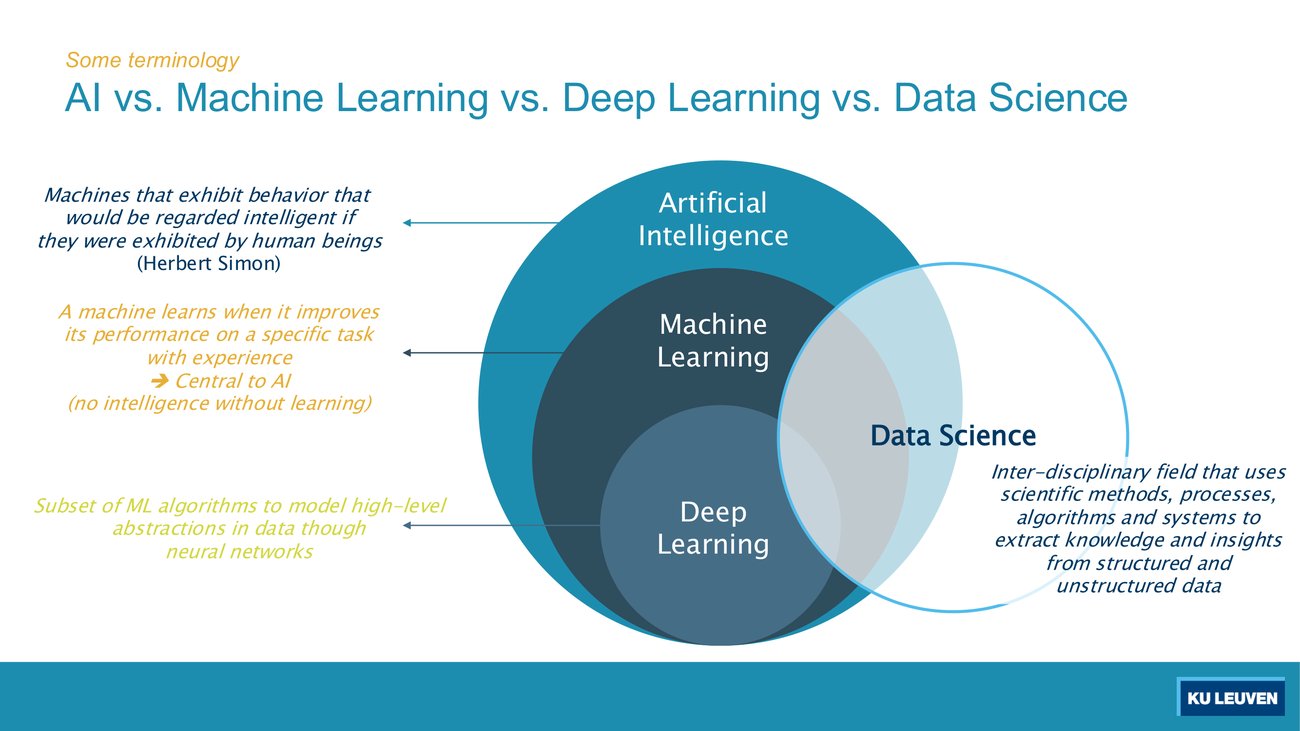
The deck opens by fixing four terms that are used interchangeably in industry and are not interchangeable here. Slide p.5 gives the definition of AI the course starts from, attributed to Herbert Simon: "Machines that exhibit behaviors that would be regarded intelligent if they were exhibited by human beings". Hold on to the shape of that sentence, because by p.56 the course will have replaced it with something much more precise, and the replacement is the examinable one.
The four terms, as p.6 defines them:
The geometry of the figure carries the argument. Deep learning is drawn strictly inside machine learning, which is drawn strictly inside AI. Data science is a separate circle that overlaps all three without being contained by any of them. So the picture says: every deep learning system is a machine learning system, and every machine learning system is an AI system, but the converse fails in both directions. The region of AI outside the machine learning circle is not empty, and it is where this course lives: search, constraint satisfaction, game trees, logic, planning and Markov decision processes are all AI and none of them is learning.
Task: name the trap
Four claims. Decide for each whether the geometry of the p.6 diagram supports it, and if not, say what the diagram actually shows.
1. Supported. The deep learning circle lies wholly inside the machine learning circle, which is the visual form of the slide's phrase "Subset of ML algorithms".
2. Not supported, and false. Machine learning is a proper subregion of AI. The whole of this course (search, CSP, games, logic, planning, MDPs) sits in the part of the AI circle outside machine learning. This is the single most common informal error about the field, and it is the reason the course exists.
3. Not supported. Data science is drawn as a separate circle that intersects AI, ML and DL. Overlap is not containment. Parts of data science (data engineering, statistics, visualisation) lie outside AI entirely, and parts of AI lie outside data science.
4. Asserted in words, not in the geometry. The slide states "Central to AI (no intelligence without learning)" as a claim next to the ML circle. Nothing in a nested-circle picture can express centrality: containment is all it can express, and containment says ML is a part of AI, not its core. Treat the arrow as the lecturer's position, and notice that it sits in tension with how the course is built. A count makes the tension concrete: slide p.9 says "split over 13 lectures" while the 2025-26 deck set has 14 numbered Parts, so lecture slots and decks do not map one to one (this pack follows the deck numbering). Set aside this introduction and the ethics lecture, which teach no technique, and ten of the twelve technique Parts are non-learning; the two that are learning are Part 12 and Part 13.
Read these as a description of the exam, because that is what they are.
Lecturer aside
"dependent on how you defined each of these aspects, how you formulated the problem, the problem will be easier or will be harder to solve. And that's something very important to realize."
(Lecturer, T1, restated in T2)
He is talking about problem formulation, and he says it in the first lecture and again in the second. It is the skill objective 2 is really about. In Part 3 you will choose a state representation, and the choice, not the algorithm, decides whether the search is tractable.
Six blocks. The table below maps each item on slide p.9 to the chapter of this pack that covers it, because the deck's block order and the deck numbering do not agree everywhere.
| Slide p.9 item | Chapter | Note |
|---|---|---|
| 1. Course overview and general introduction | Part 1 | this chapter |
| 2. Introduction to Rational Agents | Part 2 | PEAS and the environment taxonomy |
| 3a. Basics of search procedures and techniques | Part 3 | problem formulation |
| 3b. Informed and uninformed search, including A* | Part 4, Part 5 | the deck names A* on this slide already |
| 3c. Constraint Satisfaction Problems | Part 6 | |
| 3d. Games (with and without uncertainty) | Part 7, Part 8 | two lectures, not one |
| 4a. Reasoning and theorem proving in propositional and first order logic, including SAT solvers | Part 10 | listed first in block 4, numbered tenth |
| 4b. Planning | Part 11 | |
| 4c. Markov Decision Processes for Probabilistic Planning | Part 9 | listed last in block 4, numbered ninth |
| 5a. Version Spaces as an illustration of Machine Learning | Part 12 | |
| 5b. Version Spaces to find frequent patterns (pattern mining) | Part 13 | the slide's own phrasing links the two |
| 6. Ethical implications of AI | Part 14 |
Two structural facts follow from this slide. First, block 5 tells you what "machine learning" means inside FAI: version spaces and pattern mining, both symbolic, both driven by generality orderings (relations that say which hypothesis or pattern is more general than which). Second, the slide's last two lines are the programme split: "+ Exercise sessions" for everyone, "+ Project (for Bachelor students, see later)". On the postgraduate track there is no project.
Task: complete the half-described diagram
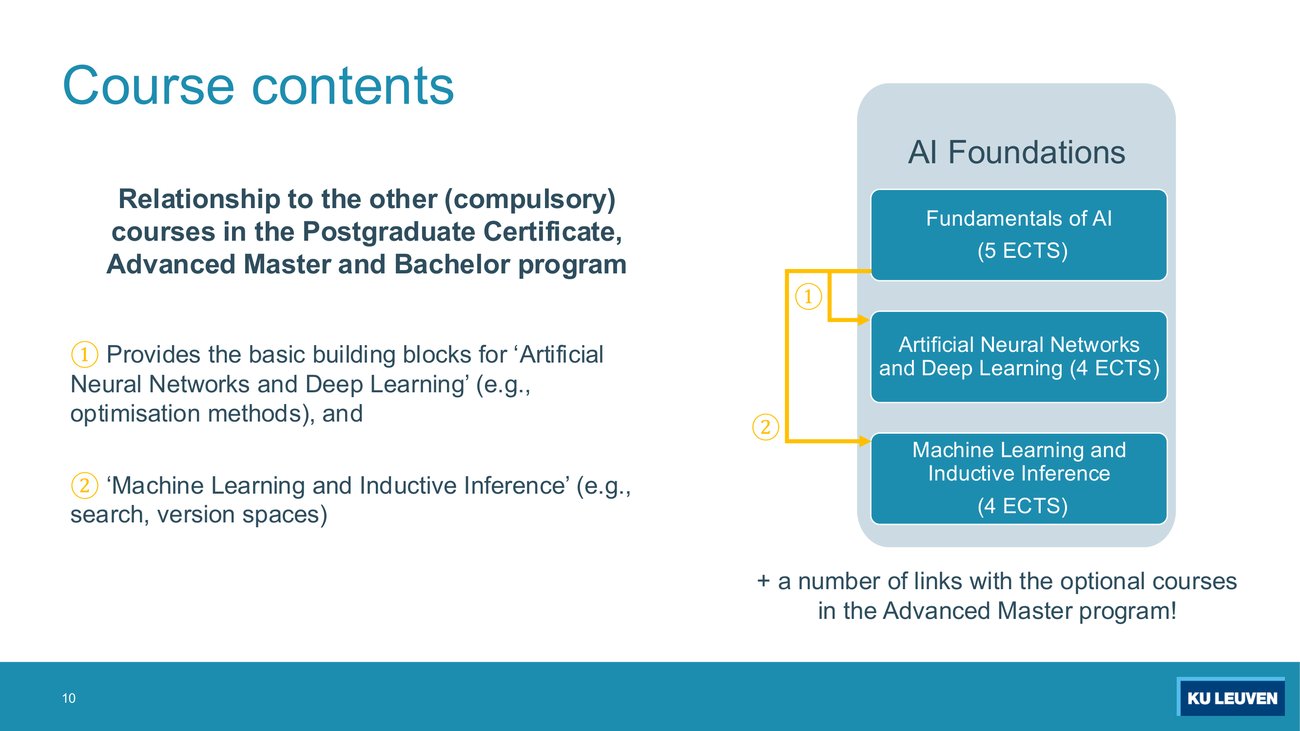
The two numbered arrows leave Fundamentals of AI. Name each target course and, more importantly, name the specific FAI content the slide says is being fed forward. Then state which FAI chapter of this pack supplies each.
Arrow 1 goes to Artificial Neural Networks and Deep Learning (4 ECTS), and the content named on the slide is optimisation methods. That is the local-search machinery (hill climbing and its relatives) which this pack covers in Part 5.
Arrow 2 goes to Machine Learning and Inductive Inference (4 ECTS), and the content named is search and version spaces, so Parts 3 to 5 and Part 12.
The slide adds that there are further links with the optional courses in the Advanced Master programme. Fundamentals of AI carries 5 ECTS and the two downstream courses 4 ECTS each, so this is the largest of the three.
Slide p.12 lists three things done before the contact hour: watch prerecorded lecture parts, read or recap upfront, and prepare the exercise session upfront. In the lecture the third was singled out: the exercise slot exists to walk through the model solution and answer questions, not to attempt the exercises cold. The slide closes with a workload arrow: reserve time in between lectures, this is a 5 or 6 ECTS course. The slide gives no hour figure. Applying the general European convention of 25 to 30 hours per credit, which is not stated anywhere in the course material, 5 ECTS works out at 125 to 150 hours in total.
Slide p.13 governs your exam on 18 August 2026 (postgraduate and advanced master, 5 ECTS):
Slide p.14 is the Bachelor variant (6 ECTS): 8/20 exercises, 8/20 theory, 4/20 programming project in three parts. It does not apply to you. If a past-paper discussion mentions the Pacman project, that is the p.14 track.
Lecturer aside: what counts as material
"the slides and the material for the exercise sessions uh are the main source of reference. So that's the basis of what you need to know uh for the evaluation."
(Lecturer, T1; also printed on slide p.15)
Slides plus exercise-session material define the scope. The two books on p.15 (Russell and Norvig, 4th edition, Pearson 2020; Poole and Mackworth 2017, free at artint.info) are background reading, useful for a second explanation, not a source of extra examinable content.
Lecturer aside: how wide "open book" really is
"an open book exercise examination in which you again can bring everything related to the course on paper. So your course notes, possible textbooks"
(Lecturer, T1)
This is wider than the official exam sheet's "course material on paper". Textbooks on paper are explicitly included. It applies to the exercise half only. The theory half is closed book: nothing on the desk.
Exam mechanics you should have decided on before you sit down
Three hours, theory first. The lecturer: "In total you will have uh three hours to take the exam. Um you will first get the theory part then get the exercise part" (Lecturer, T9). You hand in theory before the exercise half is issued, so you cannot look ahead and you cannot borrow exercise time unless you actually hand theory in early. Set a hard handover time for yourself.
Negative marking on the theory multiple choice. "you get plus uh a half a point if it is correct, minus a quarter of the point if it is wrong and zero points if uh both of the boxes are empty" (Lecturer, T9). Expected value of answering an item you believe with probability p: 0.5p - 0.25(1 - p) = 0.75p - 0.25. That is zero at p = 1/3 and positive above it. The sample block is true or false, so a pure coin flip has p = 0.5 and expected value +0.125 per item. Never leave a true or false item blank. Blank is strictly worse than guessing.
Answer-box size is a length signal. Fill-in items "can also be short answers that you need to provide", and "the boxes also give an indication of the expected length given a regular written font size" (Lecturer, T9). A three-line box is not asking for one word, and a one-line box is not asking for a paragraph.
Location. Kortrijk for postgraduate and bachelor students, Bruges for the advanced master. Confirm on your personal exam schedule.
Classic mistake: leaving true or false items blank "to be safe". The guessing correction is calibrated so that abstaining only pays below one-in-three confidence, which almost never happens on a two-way item you have studied. On eight items, blanket guessing is worth 1.0 point in expectation; blanket abstention is worth 0.
Constructed, in the sample paper's format. Arithmetic on the guessing rule quoted above (Lecturer, T9)
The theory paper's multiple choice block is eight true or false items, marked +0.5 correct, -0.25 wrong, 0 for a blank. You are confident on five of them and have no idea at all on the other three. Against leaving those three blank, what does guessing all three do to your expected mark?
Lecturer aside: what the theory half is actually testing
"the theory exam... tests both for factual knowledge as well as for synthetic knowledge... we also want to see that you can uh bring things across different chapters uh together because as you know by now uh the course is largely incremental."
(Lecturer, T9)
"Synthetic" here means across-chapter. This is why the "What this chapter assumes" and "What this sets up" links in this pack are content and not decoration: a theory question can legitimately ask you to connect the definition of rationality fixed in this chapter to the discount factor in Part 9.
Exam signal: how much of Part 1 gets asked
The August 2023 sample theory paper contains no question from Part 1 (its eight true or false items map to Parts 2, 4, 5, 6, 13, 12, 9 and 7, one each). The lecturer aims at breadth: "we try to make the exam balanced in terms of topics... you will see that it's uh very well balanced in terms of topics", while also conceding that "we cannot ask you everything" (Lecturer, T9). He also warns "I of course won't ask uh the exact same questions" (Lecturer, T9).
So: balance is his stated aspiration, not an observed property of the one paper you can see. Part 1 is cheap to examine (one true or false item on the quadrant matrix, or a one-line fill-in on what "rational" means) and expensive to ignore, because every later chapter's vocabulary is defined here. In this pack's judgment that is worth one focused hour, not five.
Classic mistake: inferring from the sample paper that Parts 1, 3, 8 and 14 are safe to skip. The sample exists to show the number and type of questions, not the topic distribution.
In this pack's judgment this is breadth material: know the eras and roughly what happened in each, know the two or three names the deck attaches to each, and move on. The one date worth fixing exactly is 1956, the Dartmouth meeting where the term was adopted, because the deck returns to it on p.43.
| Era (deck wording) | What the slide names | Why it matters later |
|---|---|---|
| 1940-1950: Early days (p.18) | 1943 McCulloch and Pitts, Boolean circuit model of brain. 1950 Turing, "Computing Machinery and Intelligence". | Turing's paper is the source of the Turing test, which anchors the "acting humanly" quadrant on p.47. |
| 1950-70: Excitement, "Look, Ma, no hands!" (p.18) | Samuel's checkers program, Newell and Simon's Logic Theorist, Gelernter's Geometry Engine. 1956 Dartmouth meeting, where the term "Artificial Intelligence" was adopted. 1965 Robinson's complete algorithm for logical reasoning. | Dartmouth supplies the p.43 definition. Robinson's principle is resolution; note that in the 2025-26 material resolution is named but no resolution procedure is taught (see Part 10). |
| 1970-90: Knowledge-based approaches (p.18) | 1969-79 early knowledge-based systems; 1980-88 expert systems boom; 1988-93 bust, the "AI Winter". | The knowledge-driven side of the "learning plus reasoning" split on p.65. |
| 1987 onwards: probabilistic reasoning and machine learning; 2001 onwards: Big Data; 2011 onwards: deep learning (p.19) | Resurgence of probability, focus on uncertainty, Bayesian networks, general increase in technical depth, agents; then faster machines and larger datasets; then neural networks breaking performance records, convolutional and generative adversarial networks. | The probabilistic turn is why Part 9 exists. Note the deck's own point that neural networks were already introduced in the 1940s: the 2011 event is not invention, it is scale. |
The "TODAY" quiz (pp.20-21). The same twelve-item list appears twice, but p.21 is not a plain repeat: it prints the verdicts as colours. The twelve items are: table tennis, quiz participation, driving a curving mountain road, driving in the streets of Paris, buying groceries on the web, buying groceries in a supermarket, discovering and proving a new mathematical theorem, conversing successfully for an hour, performing a surgical operation, putting away the dishes and folding the laundry, translating spoken Chinese into spoken English in real time, writing an intentionally funny story.
Verified from the text colours in the deck, p.21 splits the twelve items three ways. Two are printed in red: buying a week's worth of groceries in the supermarket, and performing a surgical operation. Five are printed in amber: driving safely in the streets of Paris, discovering and proving a new mathematical theorem, conversing successfully for an hour, putting away the dishes and folding the laundry, and writing an intentionally funny story. The remaining five stay in the deck's default dark blue: table tennis, quiz participation, the curving mountain road, groceries on the web, and real-time Chinese to English translation. The deck prints no legend, so the reading has to be inferred from the question "Which of the following can (not) be done at present?": dark for done, amber for partly or in progress, red for not done.
The pattern is what to retain, not the individual verdicts. Informational tasks (quiz answering, translation, web shopping) sit in the done group. Tasks requiring physical manipulation under uncertainty are the hard ones: the lecture singled out folding a towel as a standing benchmark problem in robotics, because the fabric is unknown in advance, the towel can slip from the gripper, and an early fold that is slightly wrong ruins every later one. Note one place where slide and lecture differ in emphasis: surgery is red on the slide, while in the lecture he added that some procedure types, the ones where the required view and the required actions are clearly delimited, are already possible. That dependency structure, task properties decide feasibility, is exactly the taxonomy Part 2 formalises.
Twenty pages of breakthroughs. Two of them feed directly into later chapters. In this pack's judgment the rest are context: name them and move on.
Shakey the robot (p.24). Developed in 1965 at SRI, driven by a remote-controlled computer that formulated plans for moving and acting. The slide names two people: Nilsson, associated with the STRIPS planning formalism, and Hart, associated with the A* search algorithm. Those two names return as the two central algorithms of the course: A* in Part 5 and STRIPS in Part 11. Shakey is also the first full instance of the agent loop you will meet on p.63: the photo is annotated with a television camera and bump detectors (sensors) and with drive wheels, a caster wheel and their motors (actuators). For the decision process, follow the slide's own bullet rather than the photo: the plans for moving and acting were formulated by a remote-controlled computer, so the deliberation sat off the robot even though the photo also carries an onboard logic callout. In the lecture one detail was added for scale: a single action took roughly half an hour of computation before the robot moved for a few seconds.
Foundational subdomains of AI (p.26). Eight of them: robotics, computer vision, language and speech processing, planning and scheduling, theorem proving, human computer interaction, declarative programming, machine learning. This course touches planning and scheduling (Part 11), theorem proving (Part 10) and machine learning (Parts 12 and 13) directly.
| Year | Event (deck wording, condensed where a page repeats it) | Page |
|---|---|---|
| 1997 | DeepBlue beats chess champion Kasparov | 27, 30 |
| 2005 | "Stanley", breakthrough for self-driving cars | 27, 30 |
| 2007 | Boss wins the DARPA Urban Challenge | 28 |
| 2010 | Towel folding robot | 29 |
| 2011 | IBM Watson wins 1 million dollars in the Jeopardy quiz against Brad Rutter and Ken Jennings | 30, 31 |
| 2011-2012 | Excel Flash Fill (program synthesis) | 32 |
| 2015 | Eve, the robot scientist | 33, 35 |
| 2015 | Heads-up limit hold'em poker | 34 |
| 2016 | "AlphaGo wins from 18-fold world champion Seedol in Go, a Japanese chess game" (p.35 verbatim, [sic]: the deck's spelling and its description of Go are its own) | 35 |
| 2020 | OpenAI automatically generates an article in The Guardian | 35 |
| 2022-2023 | ChatGPT | 36 |
Application slides pp.37-41 group further examples: the (bio)medical domain (combining image and language processing to support patient diagnosis; predicting protein structures for drug development), robotics (reinforcement learning teaching a robot dog to walk in an hour), computational creativity (NVIDIA's GauGAN2, OpenAI's DALL-E, a bot generating tweets, a deepfake video), and a long list of industrial applications on p.41 running from gas and electricity consumption modelling to fraud detection and smart grids. Note that reinforcement learning itself is out of scope: the lecturer says of it at the end of Part 9 that "we don't cover here", so in this pack's judgment the robot-dog slide is context rather than examinable content.
Several pages in this stretch are built around video or screenshots, and each still prints its own caption. Checked page by page: p.25 is the only page in the deck's success stretch with no text at all (Shakey footage); p.28 prints "2007: Boss wins Darpa Urban Challenge" together with a YouTube link; p.31 prints the full Watson caption, naming the champions Brad Rutter and Ken Jennings and the 1 million dollar prize. The clips were played in class; the captions are the part that stays on the page.
This is the examinable core of the chapter. Everything before it is orientation; everything after it is a consequence.
The Dartmouth proposal, McCarthy and colleagues: "Every aspect of learning or any other features of intelligence can in principle be so precisely described that a machine can be made to simulate it." That is a hypothesis about describability, and it is deliberately silent about whether the machine should think or merely behave, and about whether it should copy a human or do better. Those two silences are exactly the two axes of the matrix.
Slide p.45 introduces the axes as two different research motivations:
Stated as a test you can apply to any sentence:
| Axis | Question to ask of the definition | Left or top | Right or bottom |
|---|---|---|---|
| Thinking vs acting (vertical) | What is the object of study: the internal process, or the external behaviour? | Thinking (top row): words like think, minds, mental faculties, computations, reason. | Acting (bottom row): words like perform functions, do things, behavior, automation of behavior. |
| Humanly vs rationally (horizontal) | What is the standard of success: matching a human, or matching a norm? | Humanly (left column): the definition mentions people, humans, human thinking. The measurement is empirical, against what people actually do, defects included. | Rationally (right column): no reference to humans. The measurement is against what an ideal reasoner or actor should do. |
The horizontal axis is the one students misread. "Rational" is not a synonym for "clever" or "logical" here. It means: judged against a norm rather than against human performance. That is why a definition can mention logic and still be in the human column (if it is about how people reason), and can avoid logic entirely and still be in the rational column.
Task: fill the blank cells
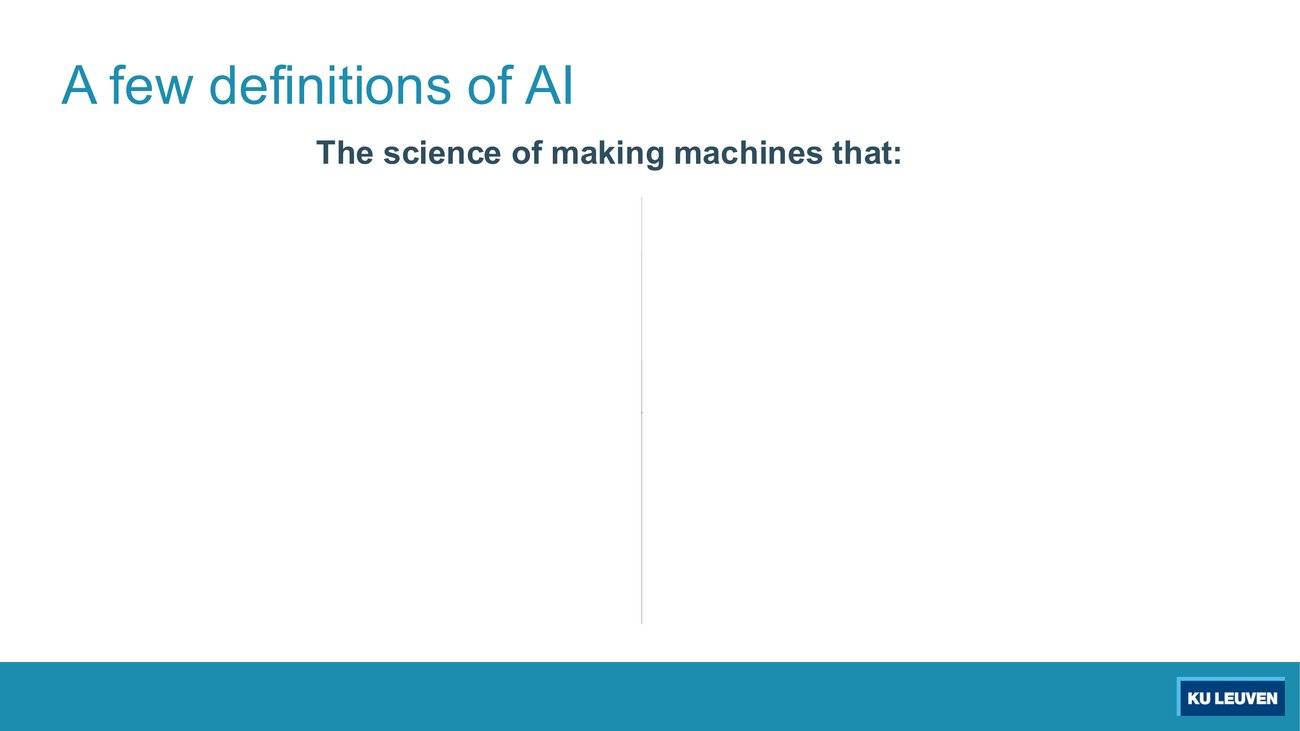
Before reading on, write the matrix out. Label both axes, fill the four cells with the deck's own wording, then mark the cell this course adopts. Finally, say in one sentence what the course's chosen cell commits you to.
| Humanly (left) | Rationally (right) | |
|---|---|---|
| Thinking (top) | Think like people | Think rationally |
| Acting (bottom) | Act like people | Act rationally ← this course |
The full header on p.44 is "The science of making machines that:", so each cell completes that sentence.
What the choice commits you to: the course judges a system only by the decisions it makes, measured against a norm (maximum expected utility), and never by whether its internal process resembles human thought or whether its behaviour is human-like. Slide p.56 states the "decisions only" half explicitly.
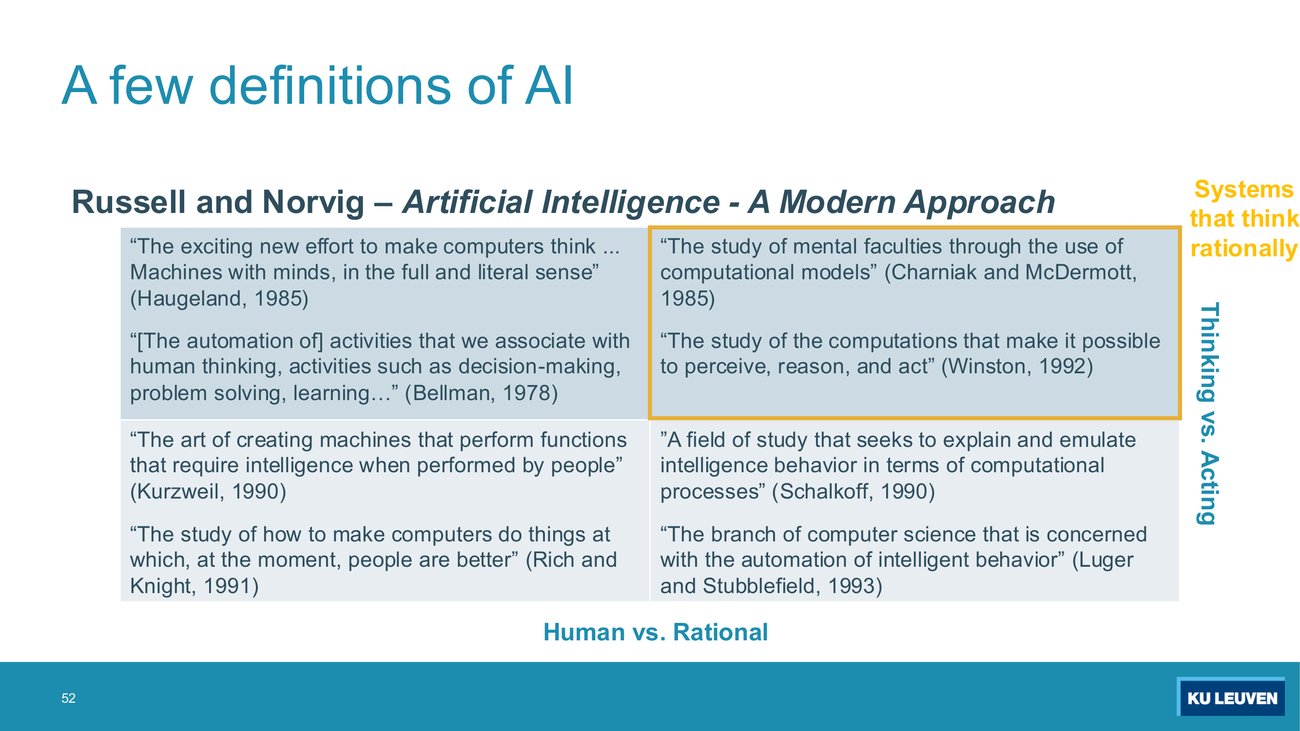
The deck shows the same eight-definition table four times, highlighting one cell each time. That build order is itself the answer key, and it is worth recording:
| Page | Cell highlighted | Definitions in that cell |
|---|---|---|
| p.46 | Systems that act like humans (bottom left) | "The art of creating machines that perform functions that require intelligence when performed by people" (Kurzweil, 1990); "The study of how to make computers do things at which, at the moment, people are better" (Rich and Knight, 1991) |
| p.50 | Systems that think like humans (top left) | "The exciting new effort to make computers think ... Machines with minds, in the full and literal sense" (Haugeland, 1985); "[The automation of] activities that we associate with human thinking, activities such as decision-making, problem solving, learning..." (Bellman, 1978) |
| p.52 | Systems that think rationally (top right) | "The study of mental faculties through the use of computational models" (Charniak and McDermott, 1985); "The study of the computations that make it possible to perceive, reason, and act" (Winston, 1992) |
| p.54 | Systems that act rationally (bottom right) | "A field of study that seeks to explain and emulate intelligence behavior in terms of computational processes" (Schalkoff, 1990); "The branch of computer science that is concerned with the automation of intelligent behavior" (Luger and Stubblefield, 1993) |
Task: name the trap
Winston's definition, highlighted here as thinking rationally, is "The study of the computations that make it possible to perceive, reason, and act". It contains the word "act". Kurzweil's, in the acting humanly cell, is "The art of creating machines that perform functions that require intelligence when performed by people", and contains no word about thought.
Explain, in terms of the two axis tests, why Winston is not in the acting row and Kurzweil is not in the thinking row. Then say which single word in Kurzweil's sentence fixes its column.
Winston: row. Apply the vertical test, "what is the object of study?". The object is "the computations", not the behaviour. Perceiving, reasoning and acting appear as the things those computations make possible, so they are the scope of the study, not its subject. A definition that studies internal computation is in the thinking row even when it lists behaviours.
Winston: column. No human is mentioned and no human benchmark is implied, so the standard of success is normative, hence the rational column. Top right.
Kurzweil: row. The object is machines that "perform functions", so external behaviour. Nothing is claimed about how the machine arrives at the behaviour. Acting row.
Kurzweil: column, and the decisive word. The word is "people", in "when performed by people". The yardstick is human performance, so the human column. Bottom left. Note the same structure in Rich and Knight: "things at which, at the moment, people are better" is a human benchmark, and "at the moment" makes it explicitly a moving one.
The trap in general: classify by the grammatical object of the definition (what is being studied or built) and by the yardstick named (human or norm). Do not classify by whether the sentence happens to contain the verbs "think" or "act".
Task: full placement drill
Cover the table above. Place all eight definitions from memory by author, then check. Score yourself out of eight.
| Humanly | Rationally | |
|---|---|---|
| Thinking | Haugeland 1985 Bellman 1978 | Charniak and McDermott 1985 Winston 1992 |
| Acting | Kurzweil 1990 Rich and Knight 1991 | Schalkoff 1990 Luger and Stubblefield 1993 |
Memory hooks that survive the exam: minds and human thinking go top left; mental faculties and computations go top right; people goes bottom left; behavior with no people in the sentence goes bottom right.
Constructed, in the sample paper's format. Part 1 has no 2023 item (reference A item 3)
Place this definition in the four-quadrant matrix: "The study of mental faculties through the use of computational models" (Charniak and McDermott, 1985).
Constructed, in the sample paper's format, true or false. The item the exam-signal box below names, made answerable
True or false: the Turing test belongs to the systems that think like humans quadrant.
Exam signal: the shape a Part 1 question would take
The 2023 sample paper has no Part 1 item, so there is no sample wording to memorise. The question types the theory half uses are multiple choice (true or false), fill-in and open. Applied to this matrix, the plausible forms are: a true or false item asserting a placement (constructed "The Turing test belongs to the systems-that-think-like-humans quadrant"), or a fill-in giving a definition and asking for its cell, or one line asking what "rational" means in this course.
Classic mistakes, in order of how often they cost marks: (1) putting the Turing test in thinking humanly, because a test of conversation feels like a test of mind; it is in acting humanly, and the deck places it there on pp.46-47. (2) Reading rationally as "logically", which then drags every logic-flavoured definition into the right column regardless of whether it is measured against people. (3) Reading humanly as "about humans", which drags Charniak and McDermott's "mental faculties" left; the test is whether human performance is the standard, not whether the subject matter is cognition.
Slide p.47 pairs the cell with Alan Turing and the Turing test: an interrogator in one room questions an unseen respondent in another and must decide whether it is a human or a machine. The test is behavioural by construction, which is exactly why it sits in the acting row: it inspects the transcript, never the mechanism. In the lecture one nuance was added: Turing's original formulation was quantified, predicting that by 2000 an interrogator would be fooled in roughly 70 percent of cases after five minutes of questioning, so the criterion has a time budget and a success rate, not a binary verdict.
Slides p.48 and p.49 supply the critique. The Loebner Prize is an annual competition in the format of a standard Turing test; the slide notes it was "Won three times by Alice, which is unable though to pass the Turing test", and that Marvin Minsky (of Dartmouth) "promised a prize for the person that can stop the Loebner Prize competition". A.L.I.C.E. (Artificial Linguistic Internet Computer Entity) is described on p.49 as inspired by Joseph Weizenbaum's classical ELIZA program, "with still a lot of pattern matching". The point of these three slides together: winning a behavioural imitation contest is not evidence of the mechanism, because pattern matching on the input and reflecting it back can carry a short conversation. That is the weakness of the whole cell, and the reason the course does not adopt it.
The question is "What cognitive capabilities are necessary to produce intelligent performance?". The slide sets the priorities of this cell bluntly:
That arrow is a printed scope limit, so you can rely on it. The reason given in the lecture is the same one that motivates the entire right column: human thinking is not always correct, people are demonstrably poor at logic and probability problems, and reasoning is partly emotional, so a system that faithfully imitates it inherits its defects.
The question is "What are the laws of thought? How should we think?". Two frameworks are named:
The slide also lists two problems with the cell: representing problem descriptions in a formal notation, and computational aspects. Both are course-length themes rather than passing remarks. The first is the problem-formulation skill of Part 3 and the knowledge-representation exercises of Part 10; the second is why Part 5 spends a whole lecture on heuristics and why SAT solving is hard.
So the course does not discard this cell. It borrows its machinery. What it declines is the cell's criterion: correct inference is a means here, not the definition of success.
Slide p.55 states the position the course adopts:
The second bullet needs care, because "prerequisite" and "not a necessary condition" pull against each other if you read "prerequisite" strictly. The reading that fits the rest of the deck, and the lecture, is: rational thinking is the normal route to rational action and the course will use it heavily, but it is not required, because rationality is a property of the decisions, not of the process that produced them. Slide p.56 says exactly that in its own second bullet. Practical consequence: a lookup table, a reflex, or a learned policy (a rule fixing which action to take in each state) that happens to select the utility-maximising action counts as rational in this course's sense, with no reasoning step anywhere.
The third bullet is the bridge to the next slide. Once you admit that information is incomplete, "achieve your goals" is not yet a decision rule, because you cannot guarantee outcomes. The fix is to take an expectation.
Constructed, in the sample paper's format, true or false. Slide p.55 wording
True or false: slide p.55 states that rational thinking is a necessary condition for rational acting.
Slide p.56 is the sentence to memorise, in the sense that you should be able to produce all four bullets under exam conditions:
Constructed, in the sample paper's fill-in format (reference A item 13: short answers, and box size signals length)
Fill in, one line each. (a) Being rational means ....................................... . (b) Rationality concerns only ......................................., and explicitly not ....................................... .
(a) maximizing your expected utility. (b) what decisions are made; not the thought process behind them. Both are p.56 verbatim, and the same slide supplies the two supporting bullets: rational means maximally achieving pre-defined goals, and goals are expressed in terms of the utility of outcomes.
What earns the marks: the word expected in (a), because "maximize your utility" quietly drops the entire uncertainty half of the course, and the explicit exclusion in (b), because that one clause is what rules out both left-hand quadrants. A one-line box is not asking you to explain utility theory.
The slogan is worth taking apart word by word, and the deck itself does that on pp.58-61. The order below is the deck's build order, which is also the order the lecture spoke: Maximize (p.58), Utility (p.59), Expected (p.60), Your (p.61). Each word is a different piece of machinery in a different later chapter.
| Word | What it commits you to | Where it becomes an algorithm |
|---|---|---|
| Maximize | There is a space of alternatives, usually very large, and you must find the best element of it rather than an acceptable one. | The entire search block: Parts 3 to 8. The size of that space is the reason heuristics exist. |
| Utility | A numeric value fixed in advance that expresses how favourable an outcome is. It is a modelling choice, not something the algorithm discovers. | Part 9: the reward function R and the discount factor. Also Part 7: the evaluation function at a depth cut-off. |
| Expected | Outcomes are uncertain, so you weight each possible outcome by its probability instead of assuming the intended one. This is what makes a decision rule work under incomplete information. | Part 8 (chance nodes, meaning tree nodes where the outcome is drawn at random instead of chosen by a player) and Part 9 (the transition function T(s,a,s') inside the Bellman update, the one-step rule that rewrites a state's value from the values of its successors). |
| Your | Utility is indexed to one agent. In a world with several agents, each has its own utility function, and you always evaluate from the perspective of the agent you are designing. | Part 7: minimax exists because the opponent maximises a different function. Part 8 when the other party is a chance process rather than an adversary. |
On the utility point, the lecture used route planning as the canonical case: for a route planner, the utility is the negative of travel time, so that maximising utility means minimising time. That sign flip is worth internalising now, because it is the standard way a cost-minimisation problem is written as a utility-maximisation problem.
Task: state the property that fails here constructed example
A route planner must choose between two routes. Utility is the negative of travel time in minutes.
1. Route A. EU(A) = -30. EU(B) = 0.7 × (-20) + 0.3 × (-55) = -14 - 16.5 = -30.5. Since -30 > -30.5, A wins, by half a minute of expected travel time.
2. It drops "expected". "Faster most of the time" is a claim about the most likely outcome (the mode), not about the probability-weighted average. Maximum expected utility is not the same rule as "most likely to be best", and this example is built so that the two disagree: the 30 percent tail is bad enough to outweigh a 10-minute gain that happens 70 percent of the time.
3. p = 5/7, about 0.714. Solve 20p + 55(1 - p) = 30, so 55 - 35p = 30, so p = 25/35 = 5/7. Check: (5/7)(20) + (2/7)(55) = 100/7 + 110/7 = 210/7 = 30 minutes exactly. Above p = 5/7 route B is strictly better; below it, A is.
Why this matters later: this is the same computation a chance node performs in Part 8, and the same one hidden inside the sum over s' in the Bellman update in Part 9. Exercise archetype A14 asks the third sub-question in exactly this form: solve an inequality with one unknown probability.
Slides pp.57-61 are not five repeats of the same slide. They are the slogan itself, built one word at a time, and the build order is the order in which the lecture explained it. Verified from the text colours in the deck: p.57 shows "Maximize Your Expected Utility" with every word in the same dark blue, then each of the next four pages picks out exactly one word in the highlight colour, Maximize on p.58, Utility on p.59, Expected on p.60, Your on p.61. The lecture runs straight through those five pages without a break and continues into the aviation analogy on p.62. Slide p.68, at the very end of the deck, prints the same four words again with no highlight: it is the closing takeaway slide, and the lecture closed Part 1 by restating in one sentence that acting rationally means an agent tries to maximise the expected utility function.
Slide p.62 makes the analogy that justifies the whole right column: the history of aviation. Early attempts to fly copied nature, strapping on constructed wings and jumping, and they failed. Flight was achieved when the goal changed from imitating birds to systematically engineering a machine that flies, which is the Wright brothers' picture on the slide. The slide's question is "Can we build machines that do X?", not "can we reproduce how humans do X?".
Transposed to AI: the human brain is the existence proof that intelligence is possible, not the specification. It makes non-rational decisions, and copying it would copy those too. So the course builds systems that perform a task correctly, and treats how a person would do it as out of scope. That is the same conclusion p.51 reached from the other direction.
Slide p.63 is the most reused diagram in the course. Learn it now and you will meet it five more times: Part 2 pp.2, 3 and 11, Part 6 p.8, and Part 7 p.2.
The bullets on p.63:
The diagram itself is a closed loop with four labelled parts. The environment sends percepts to the agent's sensors; inside the agent a box marked "?" turns percepts into a choice; the choice leaves through the actuators as actions that change the environment; the changed environment produces the next percept. The "?" is deliberately blank. Every algorithm in this course is a candidate filling of that box.
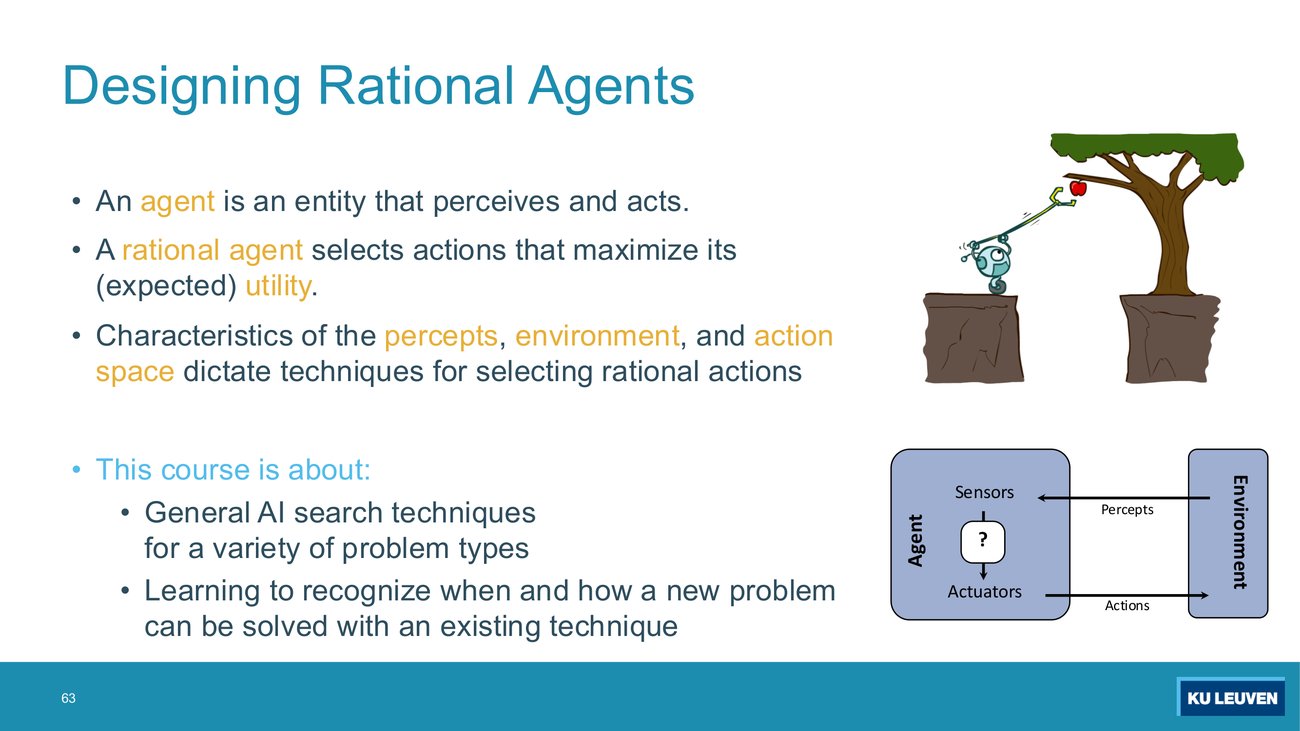
Task: complete the half-described diagram
1. Percepts run from the environment into the agent's sensors (right to left in the figure). Actions run from the agent's actuators back into the environment (left to right). The loop is closed: an action changes the environment, which changes the next percept.
2. The "?" is the agent's decision procedure: a mapping from what has been perceived to the action to take. It is the thing you design. In this course it is filled by a search algorithm (Parts 4 and 5), a constraint solver (Part 6), a game-tree evaluation (Parts 7 and 8), a policy (Part 9), an inference procedure (Part 10) or a planner (Part 11).
3. Acting rationally (bottom right). The proof is that the box is empty: the diagram specifies the interface (percepts in, actions out) and the objective (maximise expected utility), and says nothing at all about what happens inside. A definition that does not care about the internal process is in the acting row, and one whose criterion is utility rather than human resemblance is in the rational column.
4. It is reprinted in Part 2 on pp.2, 3 and 11 (where the "?" is filled with the different agent types), in Part 6 on p.8, and in Part 7 on p.2. Each time it is the reset point: here is the loop, here is the new way of filling the box.
Slide p.64 instantiates the loop with the course's running example, Pacman, which is also the environment used for the Bachelor programming project.
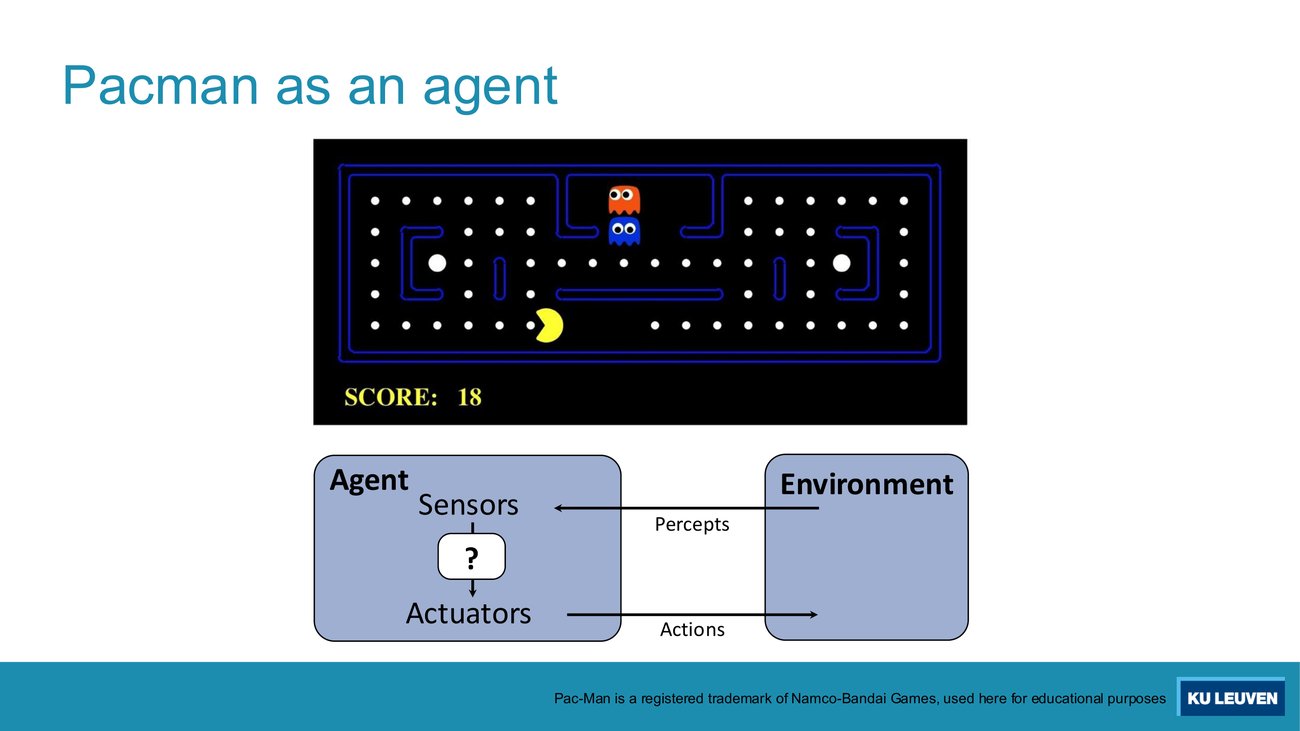
Task: fill the blank cells of the trace table
Instantiate the loop for the screenshot. Fill four rows before revealing: environment, actions, percepts, performance measure.
| Slot | Pacman |
|---|---|
| Environment | The game world, bounded by the maze walls, containing the food pellets, the power pellets and the ghosts (two on this slide, one orange and one blue). |
| Actions (actuators) | Four moves: up, down, left, right. This was established in class by question and answer at this slide. |
| Percepts (sensors) | Its own position, the wall layout, the positions of the food pellets, and the positions of the ghosts. |
| Performance measure | The score displayed on the screen (18 in this screenshot), which rises as pellets are eaten. The goal stated in class was to eat all the pellets, while the ghosts can eat Pacman. |
What you have just done is a PEAS description without the acronym. Part 2 names it: Performance measure, Environment, Actuators, Sensors, and applies it to an automated taxi driver. If this table came easily, Part 2's first section is revision.
Slide p.65 states the closing claim: "True intelligence requires integrating learning and reasoning!", and borrows Daniel Kahneman's two-system vocabulary to make the split concrete:
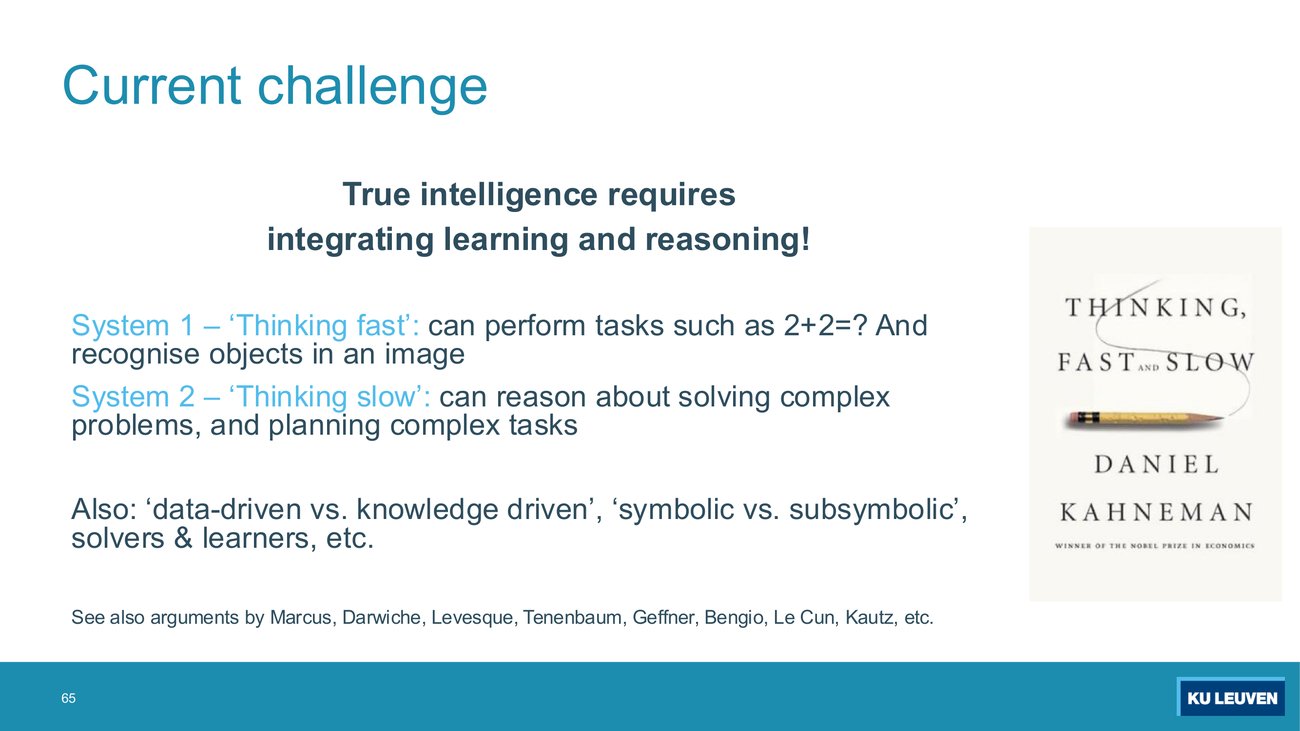
Task: name the trap in this setup
Slide p.66 repeats the claim over photographs of three failure cases, all discussed in the lecture: a car driving behind a truck whose load is a set of mobile traffic lights, a roadside billboard carrying a "70" speed-limit sign inside a campaign poster, and a "40" sign painted on the back of a bus, next to a dashboard shot of the car registering a limit. In the first case the car reacts to a traffic light; in the other two it reacts to a sign.
1. System 1 succeeds, System 2 fails. Perception is correct in all three: there really is a traffic light on the truck, there really is a 70 sign on the billboard, there really is a 40 sign on the bus, and each is recognised fast and accurately. What is missing is the inference about context: a traffic light being transported on the bed of a moving truck governs nothing, and a sign inside a poster or painted on a bus is a picture of a sign rather than a sign posted for this stretch of road. That step is reasoning over the relation between an object and the rule it instantiates, and it is exactly what a purely data-driven recogniser does not do.
2. This course is almost entirely the System 2, knowledge-driven, symbolic, "solvers" side: search, constraint satisfaction, game trees, logic and SAT, planning, MDPs. The exceptions are Part 12 (version spaces) and Part 13 (pattern mining), and even those are symbolic learners defined by a generality ordering rather than by numerical optimisation. That is the deliberate design of the course: the deep learning half of the same programme is a different course, and slide p.10 is the map of how the two meet.
Slide p.67 closes the lecture with Leuven.AI, the KU Leuven interdisciplinary AI research network, spanning machine learning, computer vision, natural language processing, robotics, special hardware, probabilistic and logical reasoning, and also law, ethics, philosophy and cognition. In this pack's judgment it is context rather than examinable content.
The lecture's own closing summary of Part 1 was one sentence: acting rationally means that an agent tries to maximise the expected utility function. If you can produce the four-quadrant matrix, place a definition in it, and unpack that sentence word by word, this chapter has done its job.
| Term | Precise definition (with page) | Plain paraphrase | Exam phrasing |
|---|---|---|---|
| Artificial intelligence (Simon) | "Machines that exhibit behaviors that would be regarded intelligent if they were exhibited by human beings" (p.5; p.6 prints the same sentence with the singular "behavior"). | If a person did it and you would call it smart, a machine doing it counts as AI. | No sample-exam wording exists for Part 1. |
| Machine learning | "A machine learns when it improves its performance on a specific task with experience" (p.6). Drawn as a proper subregion of AI. | Gets better at one job as it sees more data. | No sample-exam wording exists for Part 1. |
| Deep learning | Subset of machine learning algorithms that model high-level abstractions in data through neural networks (p.6). Drawn strictly inside ML. | Neural-network machine learning. | No sample-exam wording exists for Part 1. |
| Data science | "Inter-disciplinary field that uses scientific methods, processes, algorithms and systems to extract knowledge and insights from structured and unstructured data" (p.6). Drawn as overlapping, not contained. | Everything involved in getting insight out of data, only partly AI. | No sample-exam wording exists for Part 1. |
| Thinking vs acting axis | The vertical axis of the definitions matrix: is the object of study the internal process or the external behaviour? (pp.44, 45) | Are you studying the mind or the behaviour? | Printed on the matrix as "Thinking vs. Acting" (pp.46, 50, 52, 54). |
| Human vs rational axis | The horizontal axis: is success measured against human behaviour with all its defects, or against normative behaviour, how a rational being should think or act? (p.45) | Is the yardstick a person or a norm? | Printed on the matrix as "Human vs. Rational" (pp.46, 50, 52, 54). |
| Turing test | Turing's 1950 imitation game: an interrogator questions an unseen respondent and must decide human or machine. Behavioural, so it belongs to acting like humans, bottom left (pp.46, 47). | Fool the judge in a typed conversation. | No sample-exam wording exists for Part 1. Note the classic misplacement into "thinking like humans". |
| Loebner Prize | Annual competition in the format of a standard Turing test; won three times by A.L.I.C.E., "which is unable though to pass the Turing test" (p.48). | A chatbot contest whose winners are not actually intelligent. | No sample-exam wording exists for Part 1. |
| Rational (technical sense) | "Rational: maximally achieving pre-defined goals"; rationality "only concerns what decisions are made (not the thought process behind them)" (p.56). | Picks the best action by a yardstick fixed in advance; how it picks is irrelevant. | No sample-exam wording exists for Part 1. |
| Utility | The numeric value in which goals are expressed, defined over outcomes and fixed in advance (p.56). In Part 2 the same quantity is also called the performance measure. | The score you are trying to raise. | Appears as the reward function R and value V in the 2023 exercise Q2 (Part 9). |
| Expected utility | The probability-weighted average of the utility of the possible outcomes of an action. Being rational means maximising it (p.56). | Average score, weighted by how likely each result is. | The 2023 exercise Q2 examines policy evaluation and reasoning about gamma (its corridor moves deterministically, so no expectation over T is taken there); the expectation itself is drilled in Part 8. |
| Agent | "An agent is an entity that perceives and acts" (p.63). | Something with sensors and actuators. | 2023 theory MC 1.1 uses the related term "task environment" (Part 2). |
| Rational agent | An agent that "selects actions that maximize its (expected) utility" (p.63); "acts so as to achieve its given goals, under the assumption that its impressions of the world and its convictions are correct" (p.55). | An agent that picks the action with the best average score, given what it believes. | No sample-exam wording exists for Part 1. |
| Percept / actuator | In the agent loop (p.63): percepts are what the environment delivers to the sensors; actuators are what deliver the chosen action back to the environment. | Input from the world; output to the world. | The S and A of PEAS in Part 2. |
| System 1 / System 2 | Kahneman's split as used on p.65: System 1 ('Thinking fast') does 2+2 and object recognition; System 2 ('Thinking slow') reasons about complex problems and plans complex tasks. Same split as data-driven vs knowledge-driven and symbolic vs subsymbolic. | Fast pattern recognition vs slow deliberate reasoning. | No sample-exam wording exists for Part 1. |
Constructed, in the sample paper's format. Four course definitions, one of them the answer
Which sentence is the course's definition of an agent?
Sources for this chapter: FAI_Part1_CourseOverviewAndIntroduction_25-26.pdf (69 pages, cited by PDF page index, which equals the printed slide number in this deck) and the Part 1 lecture recording. Verbatim lecturer quotes are drawn only from the verified quote reference and attributed (Lecturer, Tn). Slide text is quoted as printed. The route-planning lottery is a constructed example and is labelled as such; its arithmetic was checked by computation.