Fundamentals of Artificial Intelligence · KU Leuven · Verbeke · 2025-26
Printed copy: all "Show answer" panels are expanded below their tasks. Cover the panel with a sheet of paper before you read the task.
Lecturer aside: why the links above the heading are content
"the theory exam... tests both for factual knowledge as well as for synthetic knowledge... we also want to see that you can uh bring things across different chapters uh together because as you know by now uh the course is largely incremental."
(Lecturer, T9)
This chapter is where the incremental course looks back at itself. If an examiner wants a question that spans chapters, the cheapest one to write is: define value misalignment, and relate it to the reward function of a Markov decision process.
Slide p.2 states the purpose of the whole Part. AI is widely covered in the media under three headings, printed as three bullets: success stories, potential dangers, ethical issues. The slide then gives the reason the topic is in a technical course at all: it is "important to inform you, studying AI and the public of the current debate that is ongoing in the AI community and beyond, to clarify issues and to take position."
Three verbs, and they are not the same. Inform is factual. Clarify means separating claims that get mixed together in press coverage, which is what most of this deck does. Take position is the one that shows up in an exam: a question that says "discuss" or "give arguments for and against" wants your position plus the reasons, not a neutral summary.
Pages 3 to 5 set the tone in two moves. Page 4 quotes Andrew Ng: "AI is the new electricity", glossed on the slide as "Much like the rise of electricity, which started about 100 years ago, AI will revolutionize every major industry", and closed with the hinge sentence "AI can bring a lot of good to society, but there are also some caveats". Page 5 is the counterweight, titled AI as the magic wand: there is a lot of hype, the expectations are often unrealistic, the press and the companies doing AI create sensational stories, "on purpose (?)" with the question mark printed on the slide, and everybody claims to be doing AI, everybody is an AI expert, and everything is AI.
One structural detail worth noticing, because it tells you how the deck is built: pages 4, 5, 13, 14 and 15 all carry the same small header, "What does this imply?". Five slides, one question, asked once of a promise and four times of a warning. The deck is a sequence of prompts, not a sequence of results.
Page 6 is the AlphaGo image you already met in Part 1. Page 7 puts a name next to it: Arthur Samuel, and his checkers player, with a link to the Chinook project's legacy page. That pairing is the argument, and it is the first appearance of the deck's recurring move, which is to deflate a spectacular result by tracing it back.
The lecture spells out the tracing. Samuel's checkers work in the 1950s and 1960s already used a form of alpha-beta search over the game tree together with a learned function that scores how good a board position is. Those are exactly the two objects of Part 7: the pruned minimax search, and the evaluation function that stands in for a value you cannot compute exactly. The same pairing carried IBM's backgammon and chess work and reappears in AlphaGo and AlphaZero. What changed is scale, hardware and the way the evaluation function is learned. What did not change is the shape of the algorithm.
Why this matters for reading the rest of the deck: if the technique is sixty years old and the news is new, then the news is partly about the news. That is the same claim the hype cycle makes with a graph, and the same claim p.30 makes with a headline.
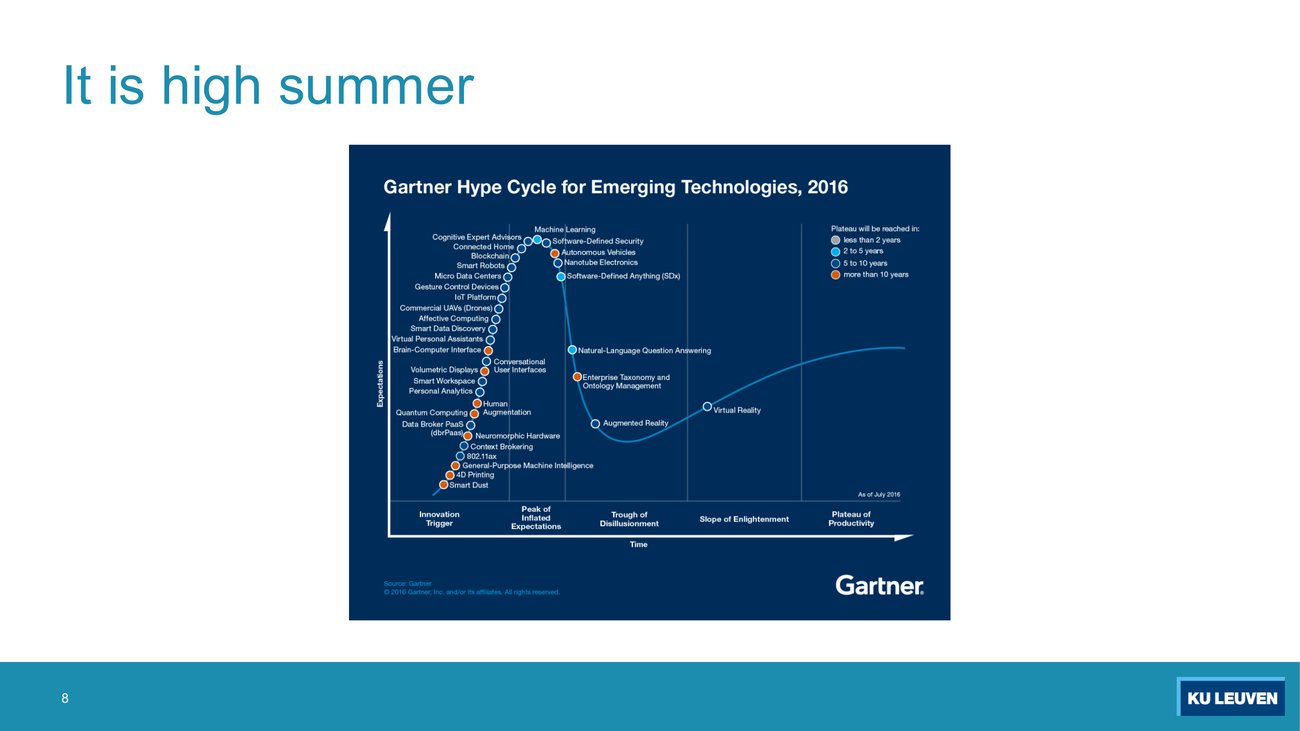
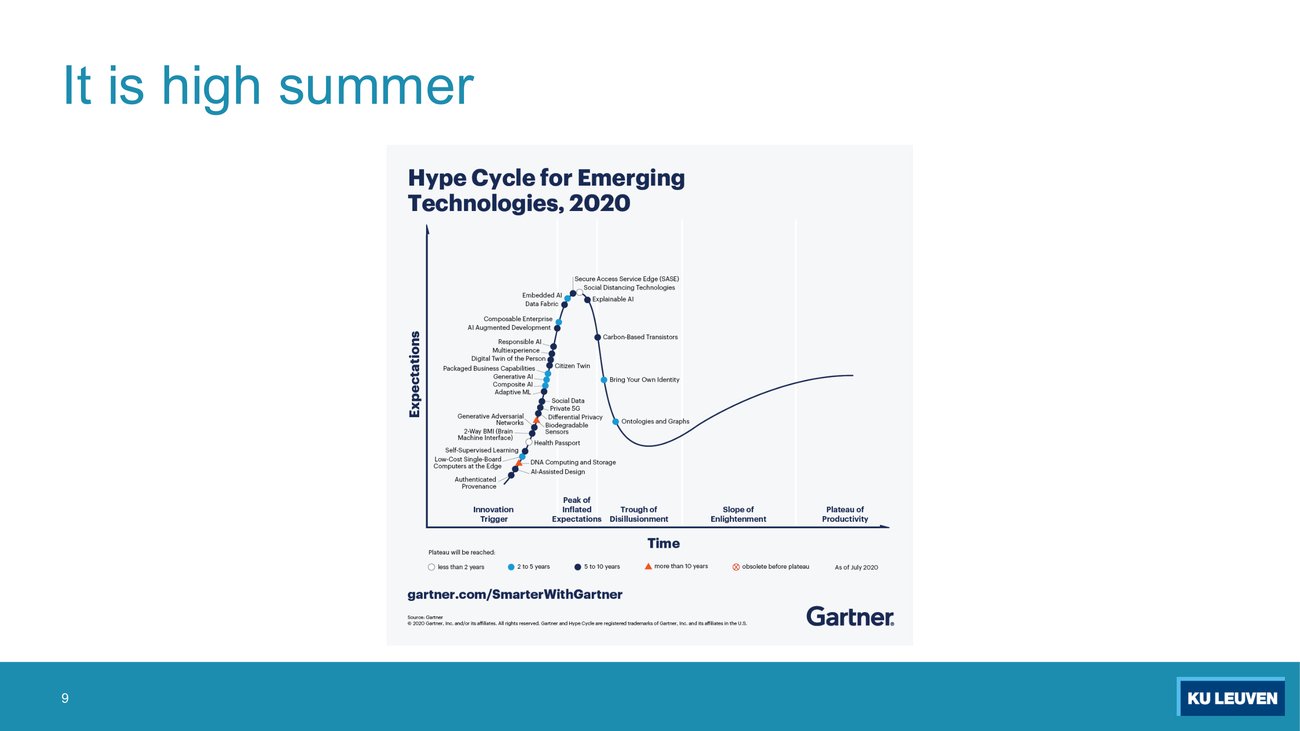
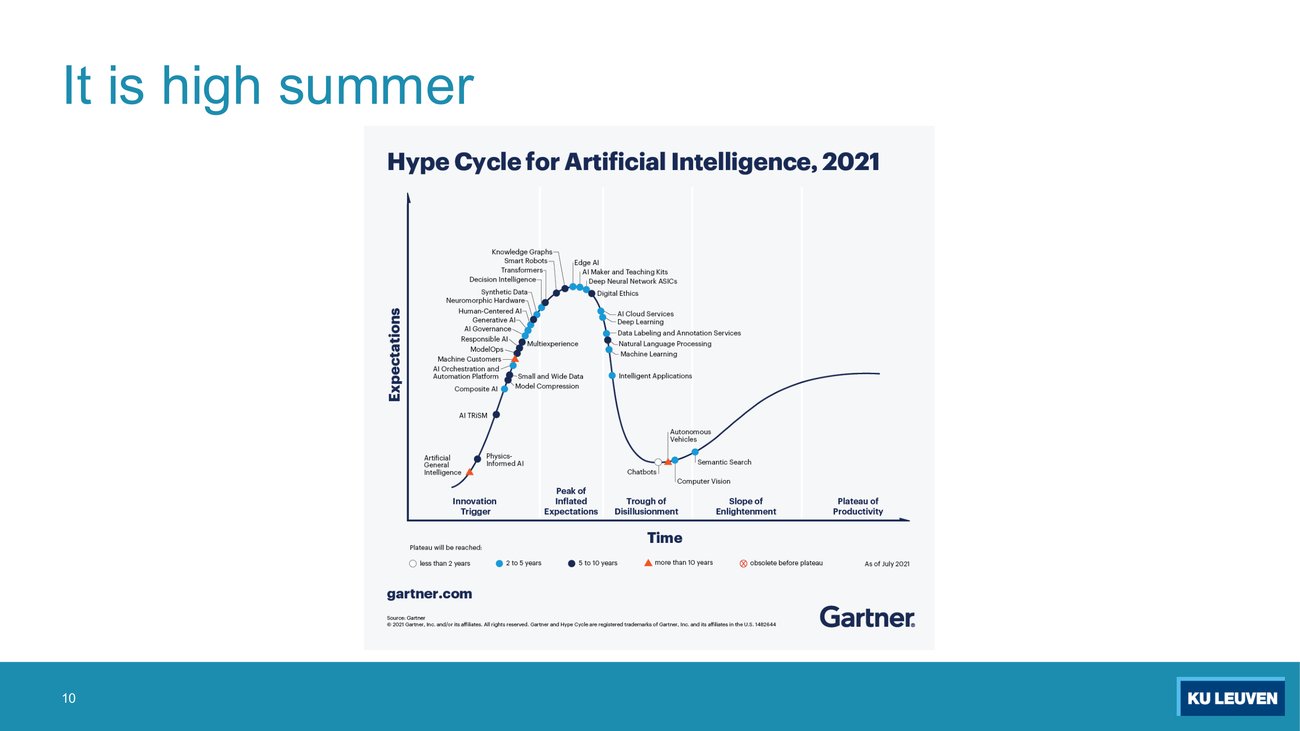
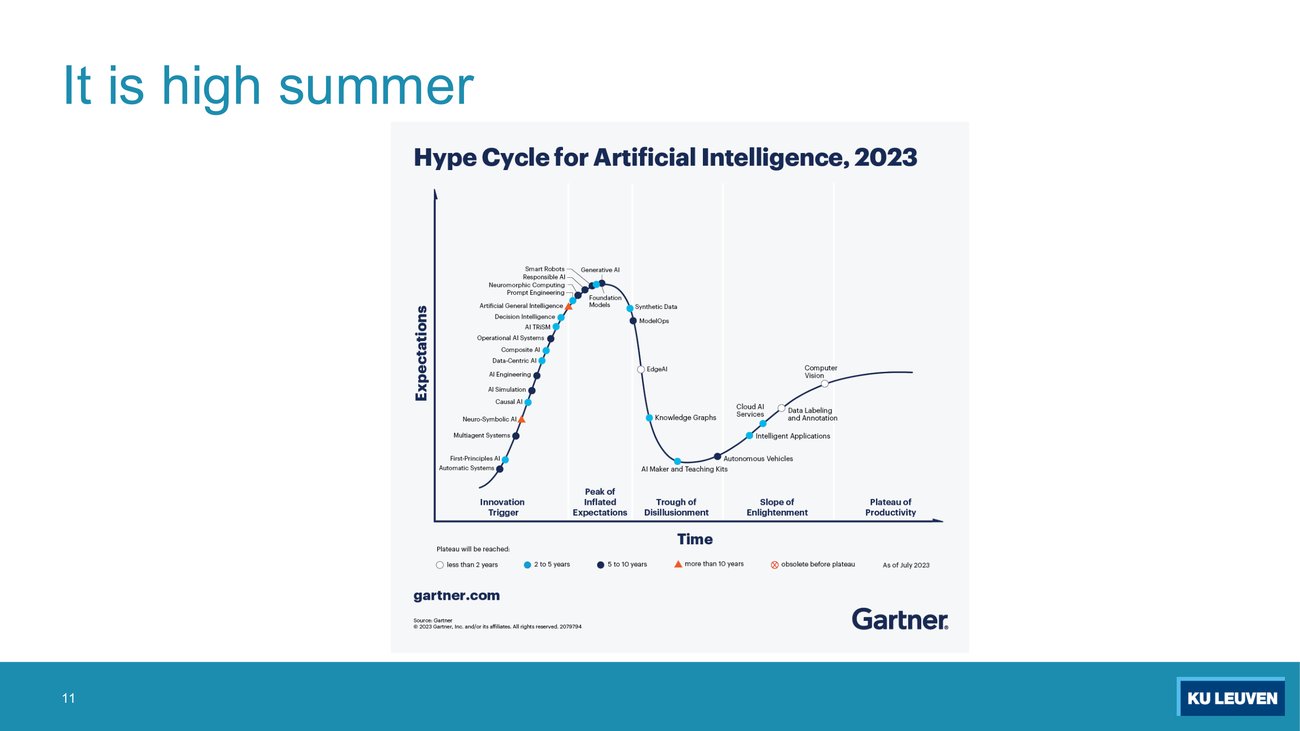
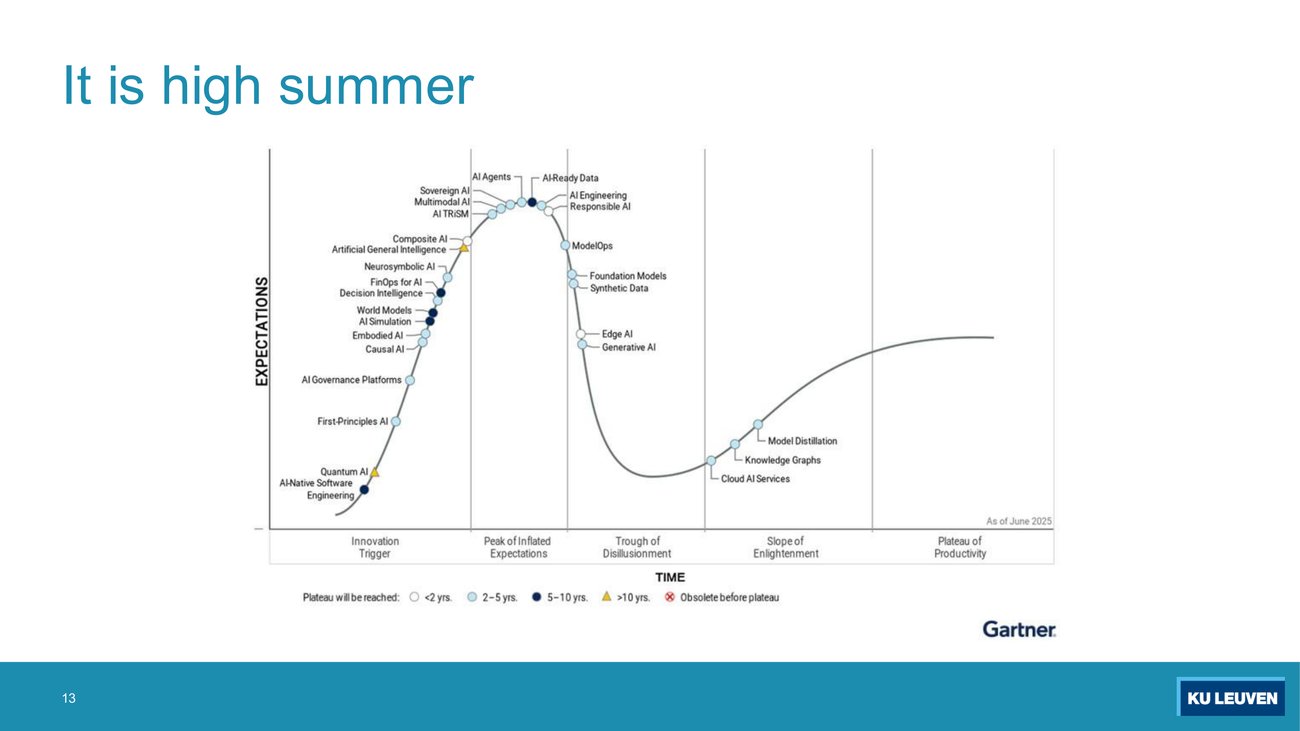
Five slides, all titled It is high summer, each showing one Gartner hype cycle. Read them as one object with four editions.
A hype cycle is a claim about expectations over time, and about nothing else. The vertical axis is labelled Expectations. It is not adoption, not market size, not accuracy, not capability. The horizontal axis is Time, with no units. A technology is drawn as a dot on the curve, and the colour or shape of the dot encodes one extra number: how long Gartner estimates it will take that technology to reach the plateau, in bands (less than 2 years, 2 to 5, 5 to 10, more than 10, and obsolete before plateau).
The curve has five named phases, printed along the bottom of every edition:
Two consequences follow, and both are the kind of thing a "discuss" question wants. First, a dot in the trough is not a verdict that the technology failed; the model's own prediction is that it continues to the slope and the plateau. Second, the position of a dot says nothing about how well the technology currently works. It says how loudly it is currently being talked about relative to what it delivers.
Task: read the axes before the labels
Without looking at any technology name, answer two questions. (a) What quantity does the vertical axis measure? (b) Name the five phases in order, left to right. Then find General-Purpose Machine Intelligence on the chart and say what its marker colour encodes.
(a) Expectations, printed on the axis. Not adoption, not performance, not revenue.
(b) Innovation Trigger, Peak of Inflated Expectations, Trough of Disillusionment, Slope of Enlightenment, Plateau of Productivity.
General-Purpose Machine Intelligence sits low on the rising slope, still inside the Innovation Trigger band, and carries the orange marker, which the legend defines as "more than 10 years" until the plateau. Keep that marker in mind: section 3's last task follows it across nine years.
Why it matters: candidates lose the point on this material by describing the curve as a life cycle of a technology's usefulness. It is a life cycle of the talk about it.
Task: name the trap in this setup
The legend at the bottom has five entries. Four of them are time bands. What is the fifth, and what does its existence tell you about how to read a dot that is high on the curve?
The fifth entry is obsolete before plateau. Its existence is the admission that the curve is not a guarantee: a technology can be at the peak of inflated expectations and still never reach productive use at all. So a high dot means high expectations, plus a separate and independent estimate of whether and when the plateau will be reached.
Read together with the 2016 edition, the pair also shows the second thing this deck wants you to see: many of the labels here are AI labels (Explainable AI, Responsible AI, Generative AI, Adaptive Machine Learning, Composite AI, Generative Adversarial Networks), on a chart that is not about AI. That crowding is the reason the next three editions are AI-only charts.
Task: state what changed between p.9 and p.10
Compare the two chart titles. One word changes, and it changes what the chart is a chart of. What is it, and why would a lecture on the AI debate bother to show you both?
Pages 8 and 9 are the Hype Cycle for Emerging Technologies (2016 and 2020). Pages 10, 11 and 12 are the Hype Cycle for Artificial Intelligence (2021, 2023, 2025). AI stopped being one entry among the emerging technologies and acquired a hype cycle of its own, populated entirely by AI subfields.
That is the deck's evidence for its own title. "It is high summer" is not a mood; it is the observation that one field now needs a whole chart, and that the chart is full.
Task: predict the next step before revealing
Find Generative AI on this 2023 chart. Say where it is, then predict where the model says it should be two editions later, and what that prediction does and does not claim.
In 2023 Generative AI is at the very top, at the Peak of Inflated Expectations. The model's prediction is therefore that it descends into the Trough of Disillusionment next, then climbs the Slope of Enlightenment. Page 12 confirms the first half: in the 2025 edition Generative AI has moved to the descending side of the peak, next to Edge AI.
What the prediction claims: expectations will fall. What it does not claim: that the technology gets worse, or that it will not end up productive. Those are exactly the two inferences the press coverage makes and the curve does not support.
Task: follow one dot across four editions
Follow general machine intelligence through the four charts: 2016 (p.8, under the name General-Purpose Machine Intelligence), 2021 (p.10), 2023 (p.11) and 2025 (p.12). Two things about it change and one thing does not. Name all three.
Changes. (1) The name: General-Purpose Machine Intelligence in 2016 becomes Artificial General Intelligence from 2021 on. (2) The position: low on the innovation-trigger slope in 2016 and 2021, higher up the rising slope in 2023, and just short of the peak in 2025.
Does not change. The marker. It is the "more than 10 years to plateau" class in every single edition: an orange dot in 2016, an orange triangle in 2021 and 2023, a yellow triangle in the 2025 legend. Nine years of rising expectations and the estimated distance to a productive plateau has not moved once.
Why it matters: this is the cleanest single piece of evidence in the deck for separating the near-term concerns of section 11 from the singularity debate of section 5. Expectations about general machine intelligence have risen steadily. The estimate of when it arrives has not.
Constructed, in the sample paper's format, true or false. No 2023 item exists for Part 14 (reference A item 3)
True or false: according to the Gartner hype cycle, a technology that has dropped into the trough of disillusionment has been shown not to work.
Three slides, three quotations, all from the turn of 2014 into 2015, all carrying the same two headers: "What does this imply?" and "... in the long run". Page 13 adds a third header, "a first press story", which tells you the deck is treating these as the start of a media sequence rather than as evidence.
Note what Gates's quotation does, because it is the structure the whole deck uses. It splits the timeline in two: a near term in which machines take over work, which is a management problem, and a later term in which capability itself becomes the concern. Sections 5 to 8 of this chapter are the later term. Sections 10 to 19, which is where the exam material is, are the near one.
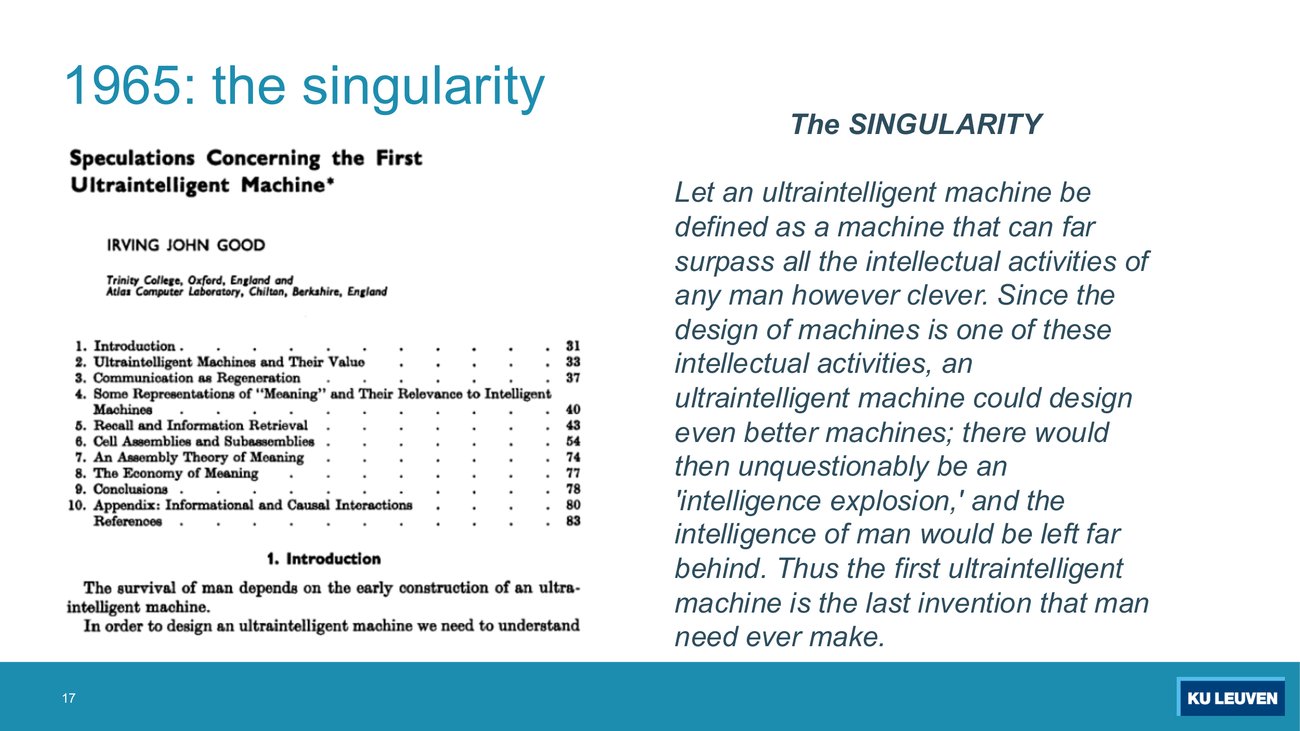
Page 16 is titled 1965: the singularity, and reproduces the opening of Irving John Good's paper "Speculations Concerning the First Ultraintelligent Machine", next to the passage that defines the idea. The passage is the definition you should be able to reproduce in your own words:
An ultraintelligent machine is a machine that can far surpass all the intellectual activities of any man however clever. Since the design of machines is itself one of those intellectual activities, an ultraintelligent machine could design even better machines. There would then be an intelligence explosion, and the intelligence of man would be left far behind. Thus the first ultraintelligent machine is the last invention that man need ever make.
Task: find the load-bearing premise
The passage is a short chain of inferences, not a single claim. Write the chain out as three steps, and then name the one premise without which the chain does not run.
Step 1. Suppose a machine exists that surpasses every human intellectual activity. Step 2. Designing machines is one of those intellectual activities, so this machine surpasses humans at designing machines, and can therefore build a better one than itself. Step 3. The better machine can do the same, so the process compounds: an intelligence explosion, after which no further human invention is required.
The load-bearing premise is step 2, the self-reference: machine design must itself be inside the set of activities the machine has surpassed. Drop it and you get a machine that is better than people at many things and still cannot improve itself, which is an ordinary tool, not a singularity. This is also why the Asilomar list gives recursive self-improvement its own principle (number 22, p.26).
Note what the argument does not contain: any statement about when, or about probability. Good gives a conditional. Everything after it in this deck is about what to do with a conditional whose antecedent nobody can date.
Page 17 gives the two outcomes that the media always sketch: utopia (war, disease and so on all disappear) or dystopia (subjugation or extermination of humans). It then prints the correction that the rest of the deck depends on: most AI research is not aimed at human-level intelligence. The systems you built in Parts 3 to 13 solve one narrow task each, with a goal handed to them.
Page 18 is the first of the two analogies and is treated in section 6. Page 19, titled Singularity, is a panel of myth-and-fact pairs from the Future of Life Institute, and it is the clearest statement in the deck of the position the AI community actually took:
Two of those three items name a myth on both sides. That symmetry is the position: the honest claim is uncertainty about timing, and uncertainty plus a large downside is an argument for preparation, not for panic and not for dismissal.
Constructed, in the sample paper's format. Two items: the discrimination this Part is most likely to test
(a) Which of the following is a near-term concern in the sense of the list on p.33, rather than part of the singularity debate?
(b) True or false: the deck's position is that the main immediate danger from AI is that systems become conscious and turn against us.
Page 18 is attributed on the slide to Stuart Russell, and it is two dates:
The argument is about the strength of a certain kind of evidence. A confident denial by the most qualified person in the field was overturned in one day. So "the leading researchers say it cannot happen" is weak evidence that it cannot happen, which is exactly the reasoning p.19 turns into "plan ahead". Note the argument is not that Rutherford was stupid; it is that expert confidence about impossibility has a poor track record in fields that are moving.
Pages 20 and 21 give the second analogy, this time with biotech. When it became possible to manipulate DNA directly, the research community itself convened, agreed a set of rules for what could be done and under what containment, and published them. Page 21 shows the artefact: the "Summary Statement of the Asilomar Conference on Recombinant DNA Molecules", Proceedings of the National Academy of Sciences volume 72 number 6, pages 1981 to 1984, June 1975, by Berg, Baltimore, Brenner, Roblin and Singer, whose opening states that the meeting was organised to review scientific progress on recombinant DNA and to discuss appropriate ways to deal with the potential biohazards of the work.
Two features of that precedent are what the AI community copied. First, the rules were self-imposed by the researchers, before any legislation. Second, they stuck, and violating them draws a reaction from inside the field rather than only from outside it. You will see the second feature again in section 13, where a journal retracts a paper after pressure from researchers. And you now know why the AI meetings in the next section carry the name of a Californian conference centre.
One slide, titled AI Community, and it is a list of institutional facts. Worth reading once for the shape rather than memorising:
The trajectory here is the point: from a workshop, to a standing agenda item at the field's main conferences, to conferences of its own, to open letters, to legislation. Pages 58 to 60, at the end of the deck, pick that trajectory up again at its current end, the EU AI Act.
Lecturer aside: how much of this is required
"I won't go through all of these... but I will just mention a few of them."
(Lecturer, T13, on pp.23 to 26)
This is an explicit scope limit, and it is the reason this section is tagged CONTEXT while the six-item list in section 11 and the seven-item list in section 19 are tagged CORE. Learn the three group headings and roughly half a dozen principles by name. Do not attempt to memorise 23 numbered items. The ones the lecture picked out are flagged below.
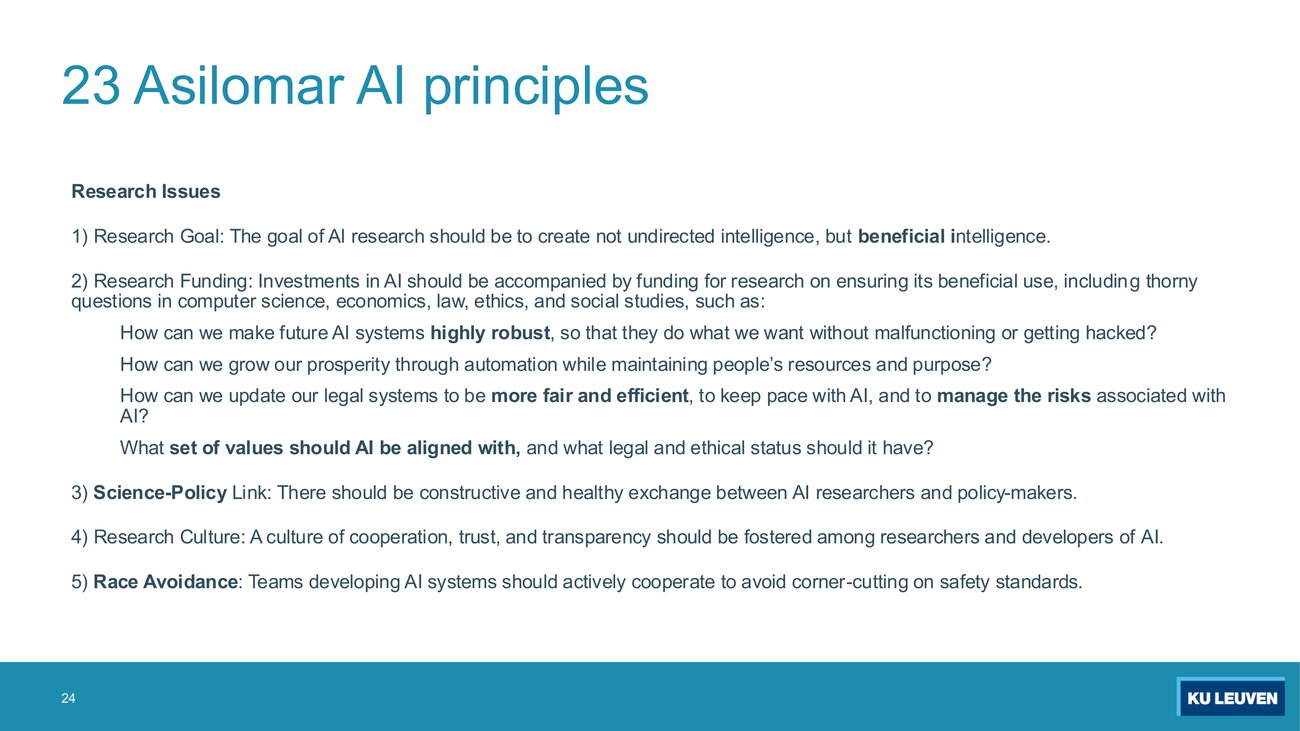
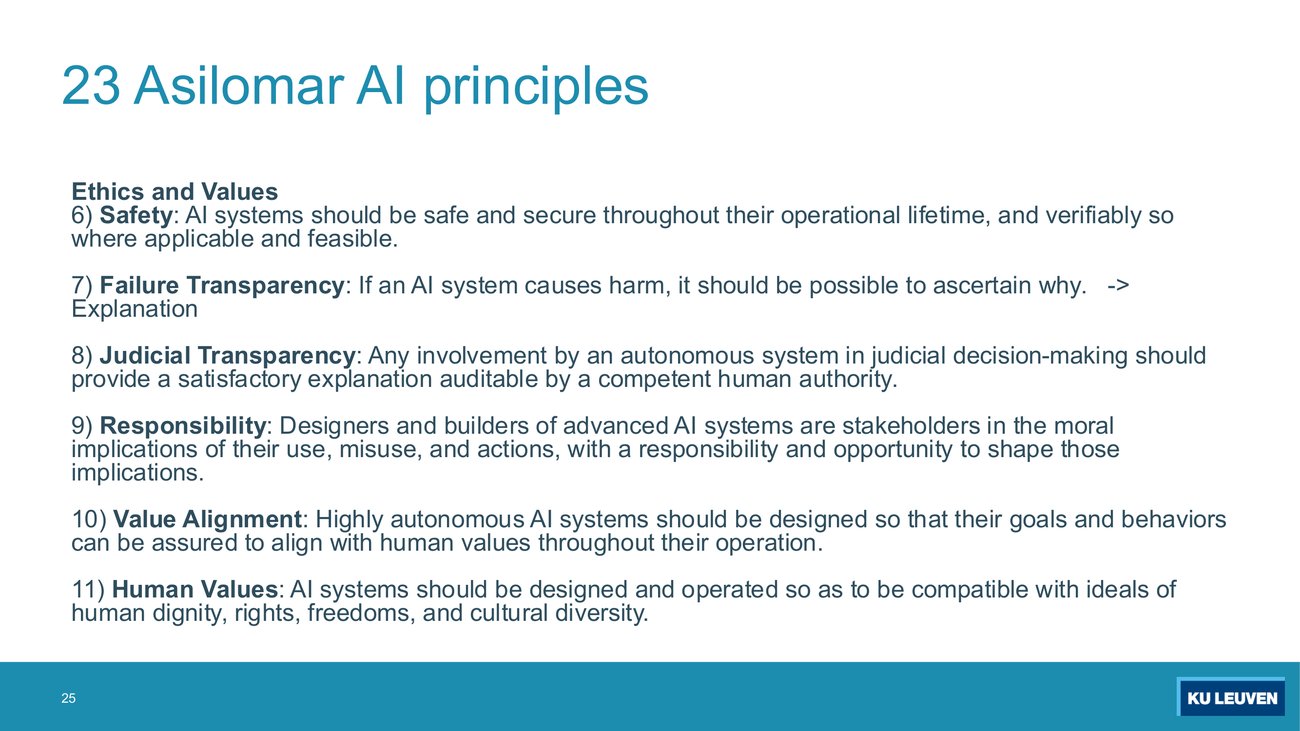
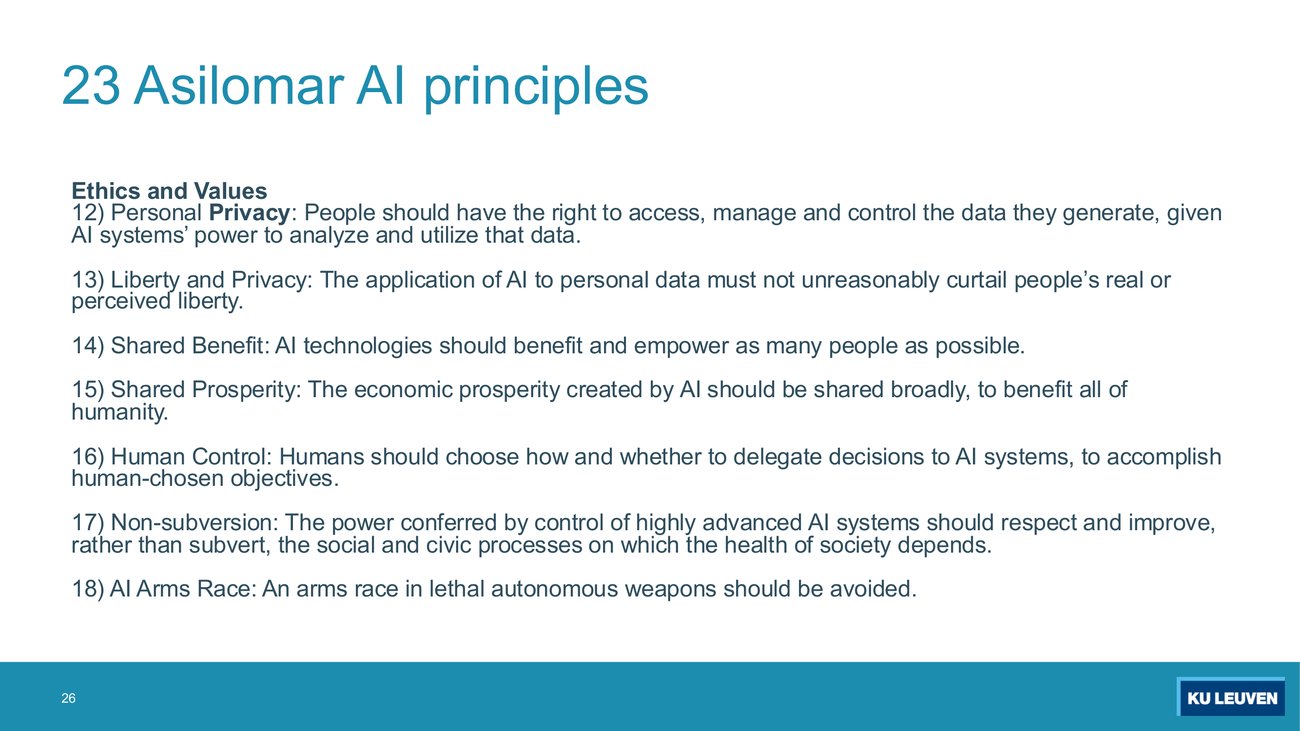
The 23 principles are printed across four slides in three groups: Research Issues (principles 1 to 5, p.23), Ethics and Values (6 to 18, pp.24 and 25), and Longer-term Issues (19 to 23, p.26). The lecture named beneficial intelligence, robustness, fairness, getting the optimisation function right, arms-race avoidance, safety, value alignment, transparency and responsibility. Notice that this short list is almost a table of contents for the rest of the deck: value alignment is section 10, transparency is section 14, the arms race is section 15.
Task: name the trap in this setup
Principle 1 says the goal of AI research should be to create not undirected intelligence but beneficial intelligence. Principle 2 says investments in AI should be accompanied by funding for research on ensuring its beneficial use, and then lists the disciplines that money should reach. Which disciplines, and why is that list the interesting part of the principle?
The slide names computer science, economics, law, ethics and social studies. It is the interesting part because it concedes that the questions raised are not computer-science questions. The four sample questions printed under it map onto the rest of the deck one to one: robustness and hacking is section 12, prosperity and purpose under automation is section 16, updating legal systems is section 17, and "what set of values should AI be aligned with" is section 10.
The trap, if you are asked to summarise the Asilomar principles, is to present them as safety rules for machines. Read principle 2 again: half of them are rules for the humans and institutions around the machine.
Task: complete the half-described mapping
Three principles on this slide are, in different words, three of the six near-term concerns you will meet on p.33. Match them: which principle number corresponds to explainable AI, which to validation and verification, and which to the misalignment problem of p.32?
7, Failure Transparency: if an AI system causes harm, it should be possible to ascertain why. The slide draws an arrow from it to the single word "Explanation", which is explainable AI (section 14). Principle 8, Judicial Transparency is the same idea narrowed to judicial decision-making, with the explanation required to be auditable by a competent human authority.
6, Safety: AI systems should be safe and secure throughout their operational lifetime, "and verifiably so where applicable and feasible". That last clause is validation and verification (section 12), including its hedge.
10, Value Alignment: highly autonomous AI systems should be designed so that their goals and behaviors can be assured to align with human values throughout their operation. That is p.32 (section 10), stated as a design requirement.
Task: predict which principle you will meet again
Section 15 of this chapter is about lethal autonomous weapons, and section 19 is about the EU requirement of human oversight. One principle on this slide is the ancestor of each. Name them, and quote the operative clause of the oversight one.
18, AI Arms Race: "An arms race in lethal autonomous weapons should be avoided." That is the one-line version of p.43.
16, Human Control: "Humans should choose how and whether to delegate decisions to AI systems, to accomplish human-chosen objectives." The operative words are how and whether: the decision to delegate is itself reserved for a human. The HLEG requirement "human agency and oversight" on p.56 is the same idea turned into a compliance obligation, with three named mechanisms.
Task: state the property that this group has and the others do not
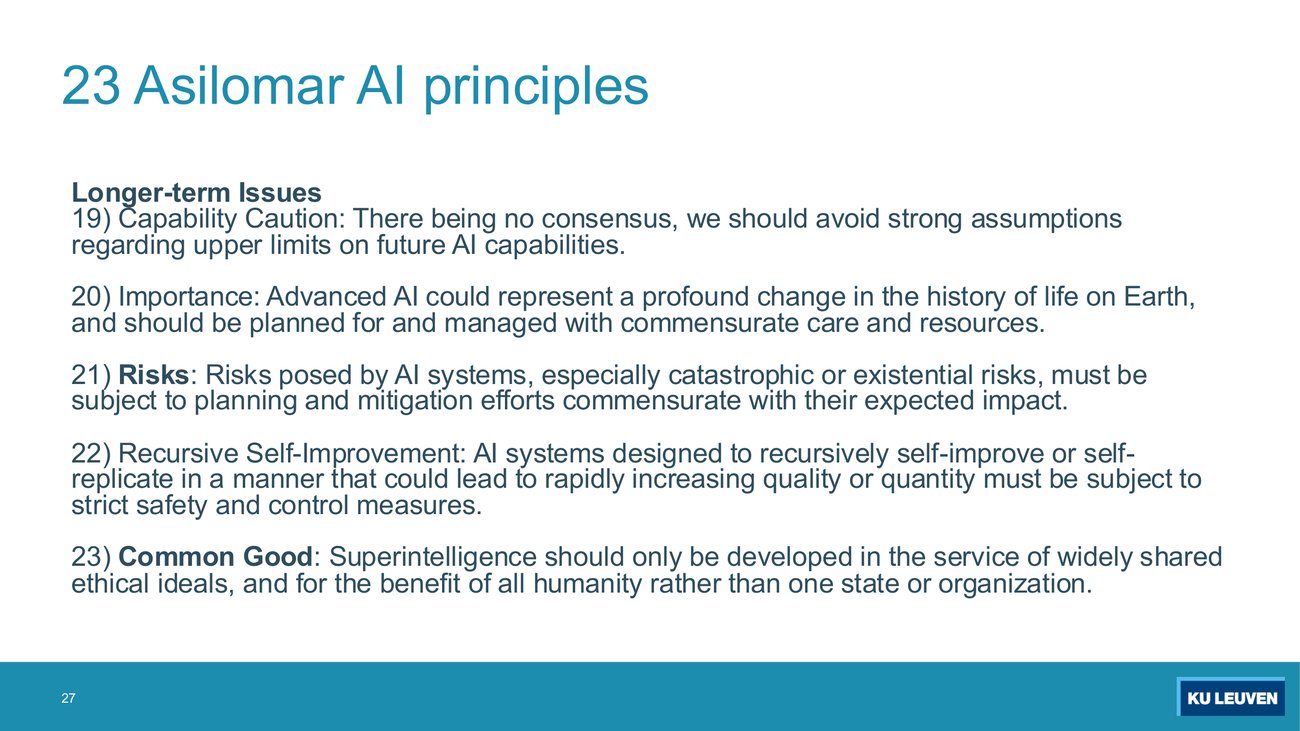
These five principles are grouped as "Longer-term Issues". Say what makes a principle belong here rather than in the previous group, and identify the two principles that are the Asilomar version of section 5's material.
They are the principles whose subject is a system that does not exist yet: future capabilities, catastrophic and existential risks, self-improving systems, superintelligence. The Ethics and Values group, by contrast, constrains systems being built now.
The two that answer section 5 are 19, Capability Caution ("There being no consensus, we should avoid strong assumptions regarding upper limits on future AI capabilities"), which is p.19's "we simply don't know" turned into a rule, and 22, Recursive Self-Improvement, which is the load-bearing premise of Good's argument turned into a safety requirement. Add 23, Common Good: superintelligence should only be developed in the service of widely shared ethical ideals and for the benefit of all humanity rather than one state or organization.
Page 28 is a divider, and it names the switch: More immediate concerns. From here to p.57 the deck is about systems that exist.
Page 29 clears the ground by naming the misconception it is clearing: the science-fiction picture, an uprising of AI systems in the manner of the Swedish series Real Humans, or the Terminator. Page 30, subtitled The role of the media, gives the mechanism by which such pictures are manufactured. It shows one headline: "Facebook's artificial intelligence robots shut down after they start talking to each other in their own language."
The lecture supplies what was behind that headline. Two agents at Facebook's AI lab were trained to negotiate against each other, maximising their own payoff, exactly the setting of Part 8 with learning attached. Once the wording of the messages was also allowed to vary, the wording came under the same optimisation pressure as everything else, so the agents drifted toward a compact code that was efficient for them and unreadable for people. The researchers wanted human-readable dialogue, judged the run uninteresting, stopped it and wrote a blog post. The blog post became a serious tech report, and the serious tech report became "robots invent secret language". Nothing in the story is a machine deciding anything about humans. It is an objective function that did not include "stay in English".
Page 31 then states the correction as four boxes, and it is worth learning these four lines, because they are the compressed form of the entire near-term half of this Part:
| The deck calls this a myth | The deck calls this the fact |
|---|---|
| Mythical worry: AI turning evil. Mythical worry: AI turning conscious. | Actual worry: AI turning competent, with goals misaligned with ours. |
| Myth: robots are the main concern. | Fact: misaligned intelligence is the main concern; it needs no body, only an internet connection. |
Read the right-hand column again with Part 1 in mind. "Competent" means good at maximising the function it was given. "Misaligned" means that function is not the one you wanted. The danger is not a failure of the machinery of Parts 3 to 13; it is that machinery working correctly on the wrong objective. Page 32 makes exactly that argument, and it is the next section.
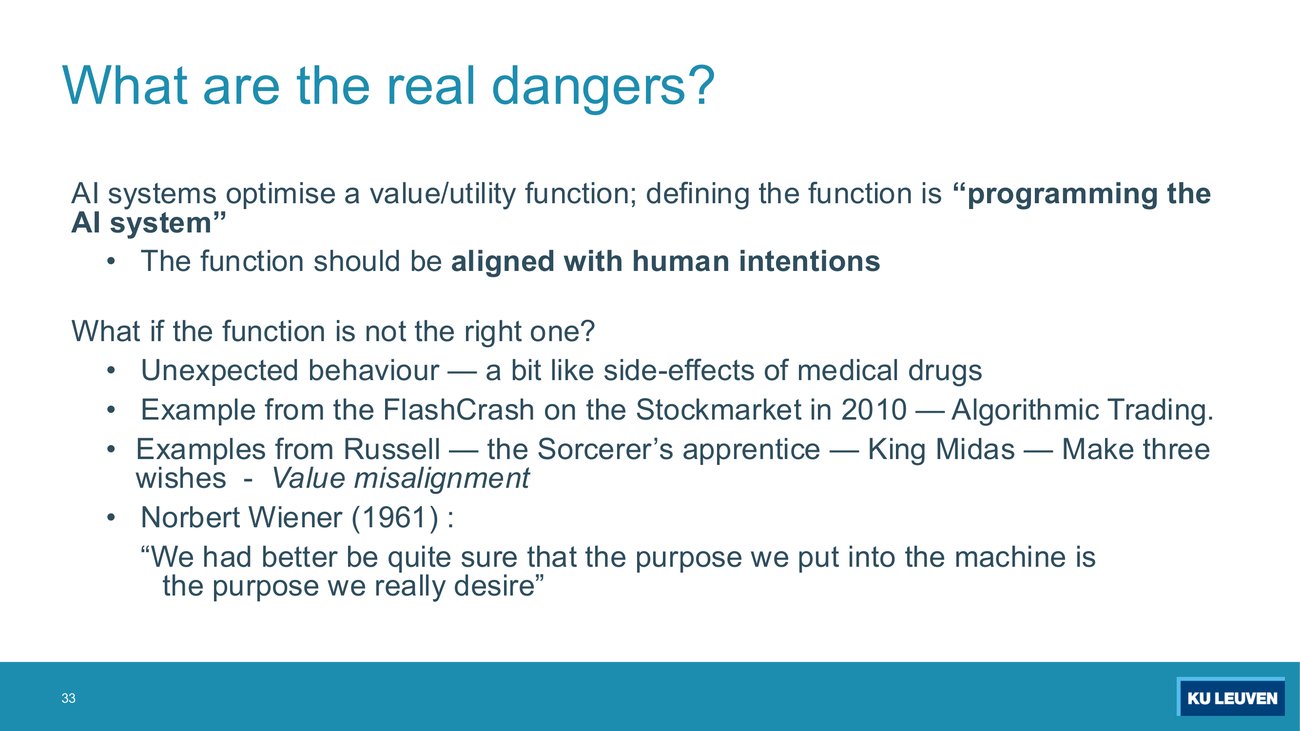
Page 32 is four claims in sequence, and they should be learned in that order because the argument only works in that order.
The slide then gives one real case and one family of parables. The real case is the Flash Crash on the stock market in 2010, under the heading algorithmic trading. The lecture fills in the mechanism, and it is worth carrying because it is the cheapest example to reproduce in an exam answer: the trading algorithms were written to sell when a price falls far enough. In a market that was already falling, every algorithm satisfied its rule at once, and the mass selling deepened the fall that triggered it. Each program did exactly what it was told. The loop between them was nobody's objective.
The parables are attributed on the slide to Russell: the Sorcerer's apprentice, King Midas, and the three wishes. All three have the same shape: a system that grants the literal request, of a requester who could not state what they actually wanted. The slide names that shape value misalignment. It closes with Norbert Wiener, 1961: "We had better be quite sure that the purpose we put into the machine is the purpose we really desire".
Task: connect it back to Part 9
Write down which component of a Markov decision process, in the tuple (S, A, T, γ, R), corresponds to the "value/utility function" of this slide. Then say which of the four algorithms of Part 9 is capable of noticing that this component was specified wrongly.
The reward function R (with γ setting how far into the future rewards count). It is an input you write down when you formulate the problem, exactly like S, A and T.
None of them. Value iteration, policy evaluation, policy extraction and policy iteration all take R as given and compute the policy that maximises it. There is no step anywhere in Part 9 that compares R against what you meant. That absence is the whole content of this slide, and the reason validation and verification (section 12) is on the list of real dangers.
Useful phrasing for an open answer: a misaligned system is not malfunctioning. It is functioning, on a specification that is wrong.
2023 sample theory exam, multiple choice 1.7, verbatim. Set as a Part 9 item; reproduced here because it is the misalignment claim written in the course's own formalism
For an MDP (S, A, T, γ, R) if we only change the reward function R the optimal policy is guaranteed to remain the same.
Constructed, in the sample paper's format, true or false. Built from the bold text on p.32
True or false: an AI system that pursues an objective its designers did not intend is, by definition, malfunctioning.
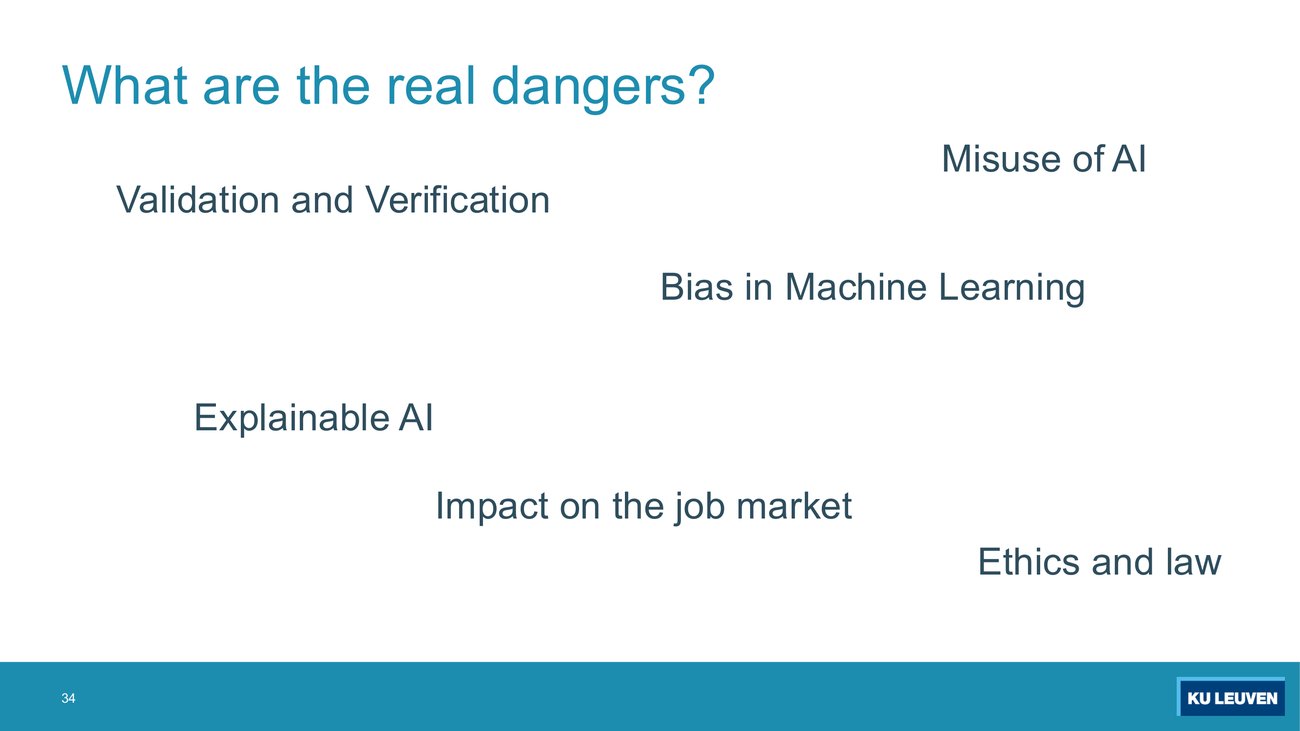
Page 33 is a bare list, scattered across the slide as a word cloud with no arrows, no numbering and no order. It is the table of contents for pp.34 to 53. Six headings:
Two things about the list are worth fixing in memory. First, it is six, not four: this pack's figure manifest labels the slide a four-risk taxonomy and that label is wrong, as the crop below shows. Second, misalignment is not on it, because misalignment is p.32, the slide before. In an answer, treat p.32 as the frame and these six as its consequences, which is how the deck is ordered: the first two items on the list, validation and explainability, are literally about detecting and exposing misalignment, and the third and fourth are about what happens when it is not detected.
Task: rebuild the list from memory, then check
Cover the figure. Write the six headings, and beside each one write a single concrete example that appears in the deck. Then uncover and check. If you can do this cold, the most likely open question on this Part is already answered.
Validation and verification: traffic-sign recognition at 98 percent accuracy, where the open question is when you may deploy it (p.35). Bias in machine learning: image search for CEO returning all white men on the first page, or Google Photo labelling black people as "gorillas" (p.36). Explainable AI: a bank refusing a loan, with a right to an explanation, from a model that is a black box (p.40). Misuse of AI: an AI virus on your phone that sets out to ruin your reputation (p.42), and lethal autonomous weapons (p.43). Impact on the job market: 15 million jobs in the United States involve operating a vehicle (p.46). Ethics and law: who is liable when a self-driving car has an accident (p.48).
A memory hook for the order, since the slide gives none: build it, check it, explain it, abuse it, and then deal with the fallout (jobs, then law). Validation and explainability are the two checks; misuse is the adversary; jobs and law are what society has to absorb.
Constructed, in the sample paper's format. Four short cases, one heading each
For each case, choose the heading from p.33 under which the deck files it.
(a) A model that scores loan applications is trained on ten years of the bank's own past decisions, and turns out to reject applicants from one district far more often than the others.
(b) The same bank refuses an application, and the applicant demands to be told why. The model is a neural network.
(c) A sign classifier is reported at 98 percent accuracy on its test set. It is now to be put in a car that will meet weather, lighting and road layouts that nobody showed it during training.
(d) Someone puts a piece of software on a target's phone whose objective is to damage that person's reputation. No robot is involved anywhere.
Constructed, in the sample paper's open-question format (2 points). Answer box: about half an A4 page, which per reference item 13 is the signal for how much is wanted
In the lecture on the AI debate, a number of concerns about AI systems are raised that are not about superintelligence but about systems being built today. Name two of them. For each, state in one or two sentences what the concern is, and give one concrete example that was used in the course.
What the marker is looking for, per the sample paper's habit of numbering the parts of an open question: (i) two headings that are genuinely on the p.33 list, (ii) a correct statement of each concern, and (iii) a concrete case per heading, taken from the course rather than invented. Two clean paragraphs earn the marks; a list of all six with no explanation does not.
Model answer, using two of the six.
Bias in machine learning. A learned classifier reproduces the regularities of the data it was trained on, including the ones that are unacceptable as decisions. So a system can be accurate, in the sense of matching its training distribution, and still be discriminatory, and the fault is not in the learning algorithm but in the data and in the decision to deploy it. Concrete example from the course: Kate Crawford's cases, such as an image search for "CEO" returning only white men on the first page of results, or facial recognition failing to recognise Asian faces. A heavier example is the Stanford work classifying sexual orientation from photographs, which reached 81 percent for men against 61 percent for humans, and which raises the prior question of whether the experiment should have been run at all, because the capability is dangerous in countries where the trait is prosecuted.
Validation and verification. Ordinary software engineering can check a program against a specification, but a system that learns changes its own behaviour, and it will be used in environments that were not covered by its training data, so it is unclear what guarantee can be given and when the system may be deployed at all. Concrete example from the course: traffic-sign recognition reported at 98 percent accuracy, where the slide's own subtitle is that reasoning as well as perception is needed, because recognising the sign is not the same as knowing whether it applies to the road you are on.
Two sentences that lift the answer, if there is room in the box: both of these are instances of the misalignment framing on the previous slide, where the function the system optimises is not the one that was intended. And both are addressed, as compliance obligations rather than research problems, by the HLEG requirements of technical robustness and safety, and of diversity, non-discrimination and fairness.
Traps. Do not use the Terminator, the intelligence explosion or superintelligence here; the question says "not about superintelligence" and p.31 files those as myths. Do not invent an example: the deck's examples are named and dated, and a named example is what distinguishes an answer that attended the lecture from one that did not.
Page 34 is six questions, and the deck leaves all six open. That is not a gap in the slide, it is the content: this is a list of things that are not solved.
The pair of words in the title carries the standard software-engineering distinction, which is worth stating because the slide assumes it: verification asks whether the system meets its specification (did we build the thing right), and validation asks whether the specification is the right one (did we build the right thing). Section 10 was the claim that the second question is where AI systems fail. This slide asks how you would ever answer either question for a system that learns.
Three of the six deserve a note:
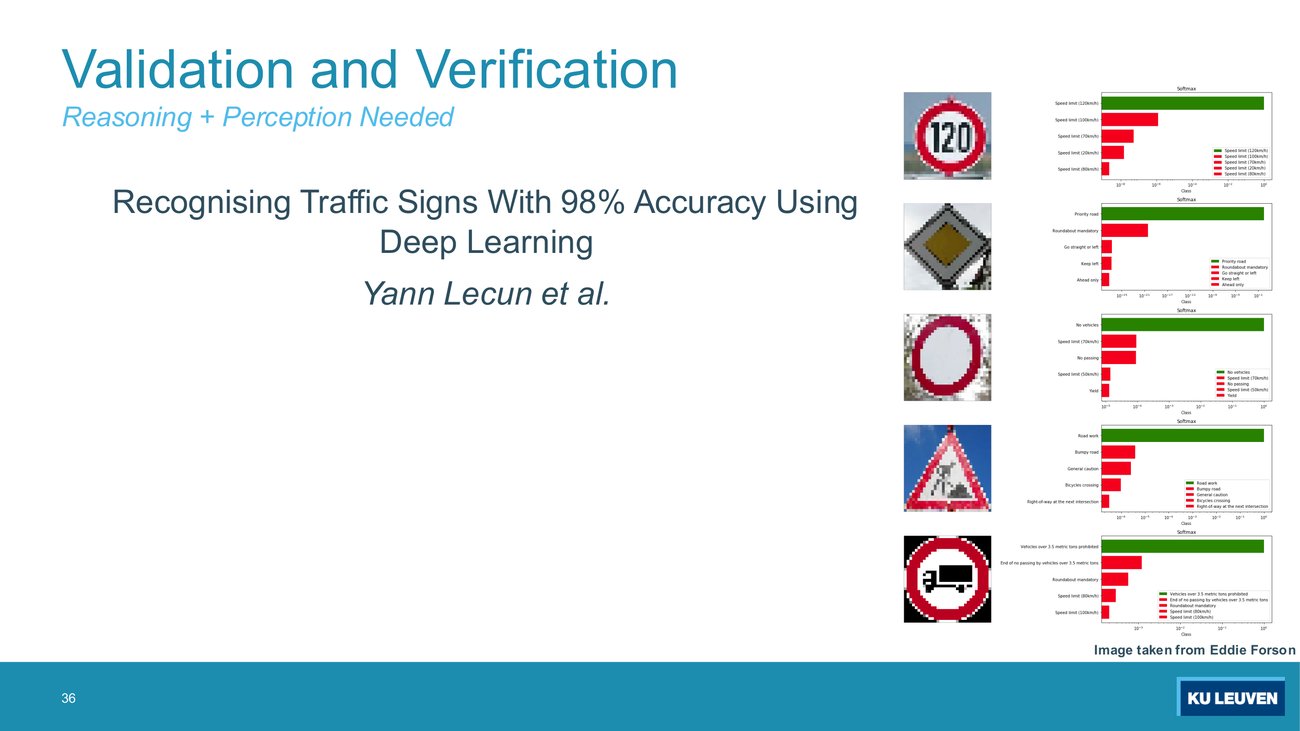
Task: name what the subtitle is objecting to
The bar charts show the classifier assigning almost all of its probability mass to the correct class on each of the five signs. The slide is nevertheless filed under validation and verification, and subtitled "Reasoning + Perception Needed". What is the objection, and what would the 98 percent have to be replaced by before you could deploy this in a car?
The objection is that the task being measured is not the task being performed. The measurement is: given a cropped image of a sign, name the sign. The task in a car is: decide what speed is now legal for this vehicle on this carriageway. A sign only means something in a context, and a classifier that sees a crop has no access to the context. The lecture's example is a sign belonging to a slip road being read while the car is still on the main carriageway: perception was correct, the decision was wrong. That gap is what "reasoning as well as perception" names.
What would have to replace the 98 percent: a guarantee that covers the situations the car will actually meet, which is what p.34 asks for and does not have. An accuracy figure is a measurement on a sample from one distribution; deployment is a claim about a different one. Note that this is not a complaint about neural networks being inaccurate; the bars are almost all correct. It is a complaint about what the number is a number of.
Constructed, in the sample paper's format, true or false. Built from the questions printed on p.34
True or false: a component reported at 98 percent test accuracy has, in the sense of p.34, been validated and verified.
Page 36 opens with the general claim, attributed to Kate Crawford at NIPS 17, and it is the sentence to memorise, because everything else in this section is an instance of it:
Every classifier that has been learned reflects the biases of the data it has been trained on.
Then the consequences: datasets often exhibit biases, and analysing datasets for granting loans or for scanning for suspects by police may yield unacceptable biases. Then Crawford's examples: an image search for CEO yields all white men on the first page of results; HP cameras' facial recognition unable to recognise Asian people's faces; Google Photo mislabelling black people as "gorillas".
Read the general claim carefully, because it fixes where the fault lives and therefore where an exam answer should put it. It is not a claim that the learning algorithm is prejudiced. It is a claim that a learner is a device for reproducing regularities, and a regularity in the data is reproduced whether or not it is acceptable as a decision. Nothing in the optimiser distinguishes the two. That is why "use a better model" is not a fix and "look at the data, and at whether the system should exist" is.
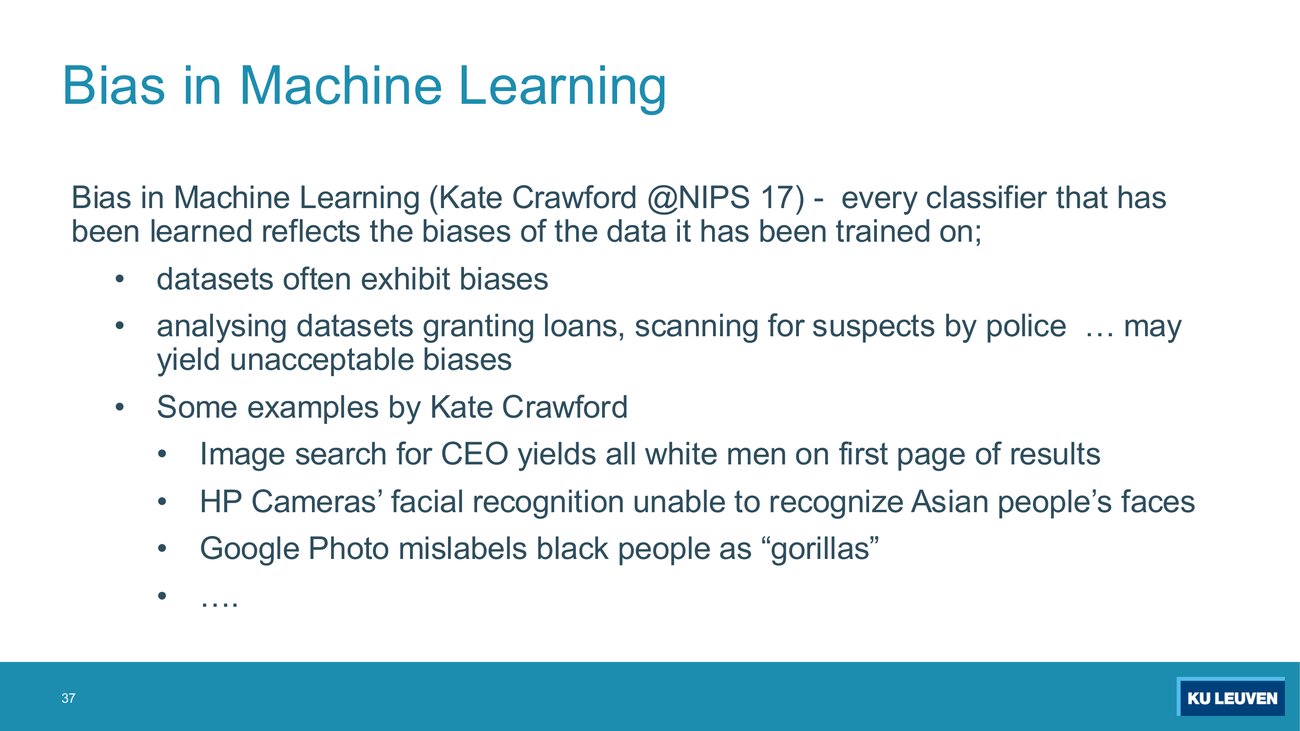
Task: state the property that fails here
A colleague proposes to fix the CEO image-search result by changing the model: more layers, better regularisation, a longer training run. Using only the first line of this slide, say why that proposal is aimed at the wrong object, and name the two places where the fault can be.
The slide says the classifier reflects the biases of the data it has been trained on. Changing the model changes how faithfully the regularities of that data are reproduced; it does not change which regularities are there. A better model, fit to the same data, reproduces the same pattern more reliably.
The two places the fault can be: the data (what was collected, from whom, labelled by whom, over which period), and the decision to deploy at all for this purpose, which is the question p.37 forces. The deck's third place, downstream, is transparency: you cannot even see the pattern without the explanation machinery of section 14.
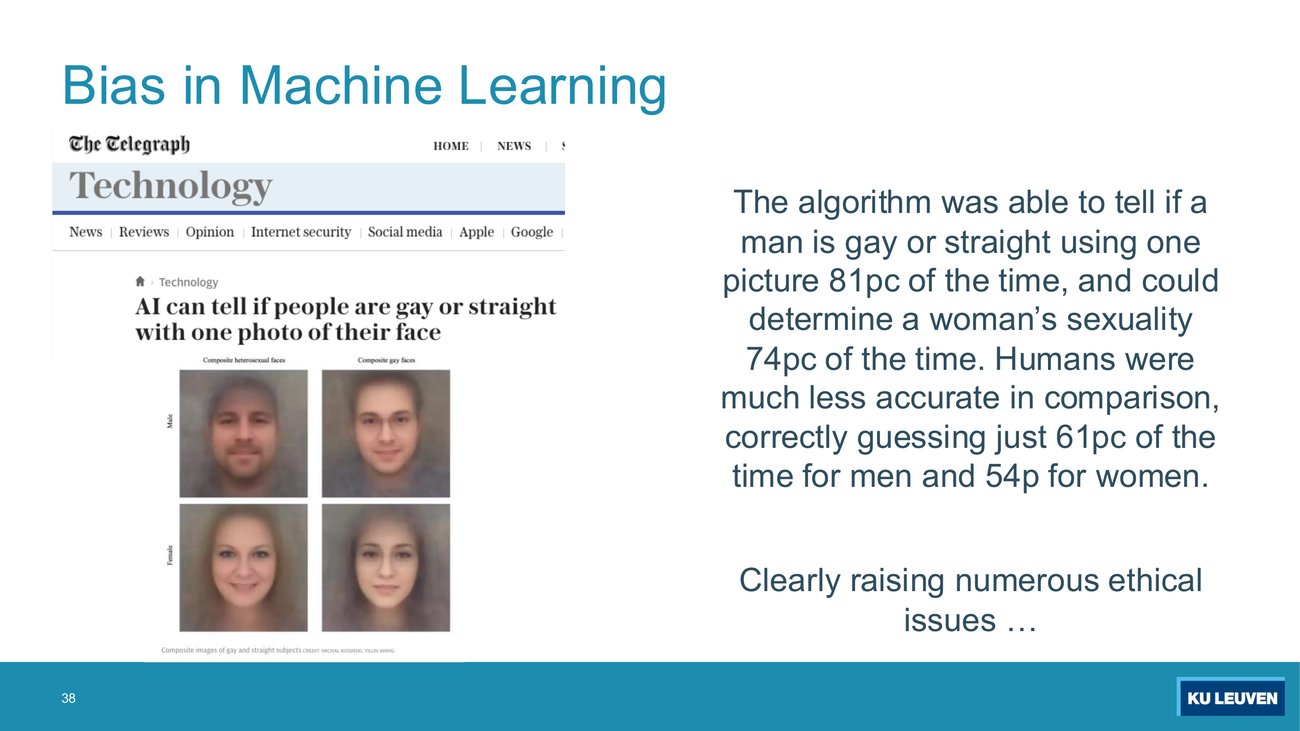
Task: name the trap in this setup
A defender argues: the algorithm reached 81 percent on men where humans reached 61 percent, so it is better than people, and better is good. Give two objections. One is printed on the slide; the other was made in the lecture and concerns what the model was keying on.
Objection 1, printed on the slide: "Clearly raising numerous ethical issues". Accuracy is the wrong axis. The prior question is whether this classifier should have been built, given that the trait it predicts is prosecuted in a number of countries, so a working version of it is a tool for finding people to prosecute. A higher number makes that worse, not better.
Objection 2, from the lecture: attempts to reproduce the result indicated that the classifier was partly keying on how the photograph was taken and on features such as the presence of glasses, that is, on artefacts of the dating-site images rather than on the trait claimed. So the headline number is not even a measurement of what the headline says it measures. This is the same failure as section 12's traffic sign: a number attached to the wrong task.
Keep both objections. The first is about ethics, the second about validity, and an answer that gives only one of them is half an answer.
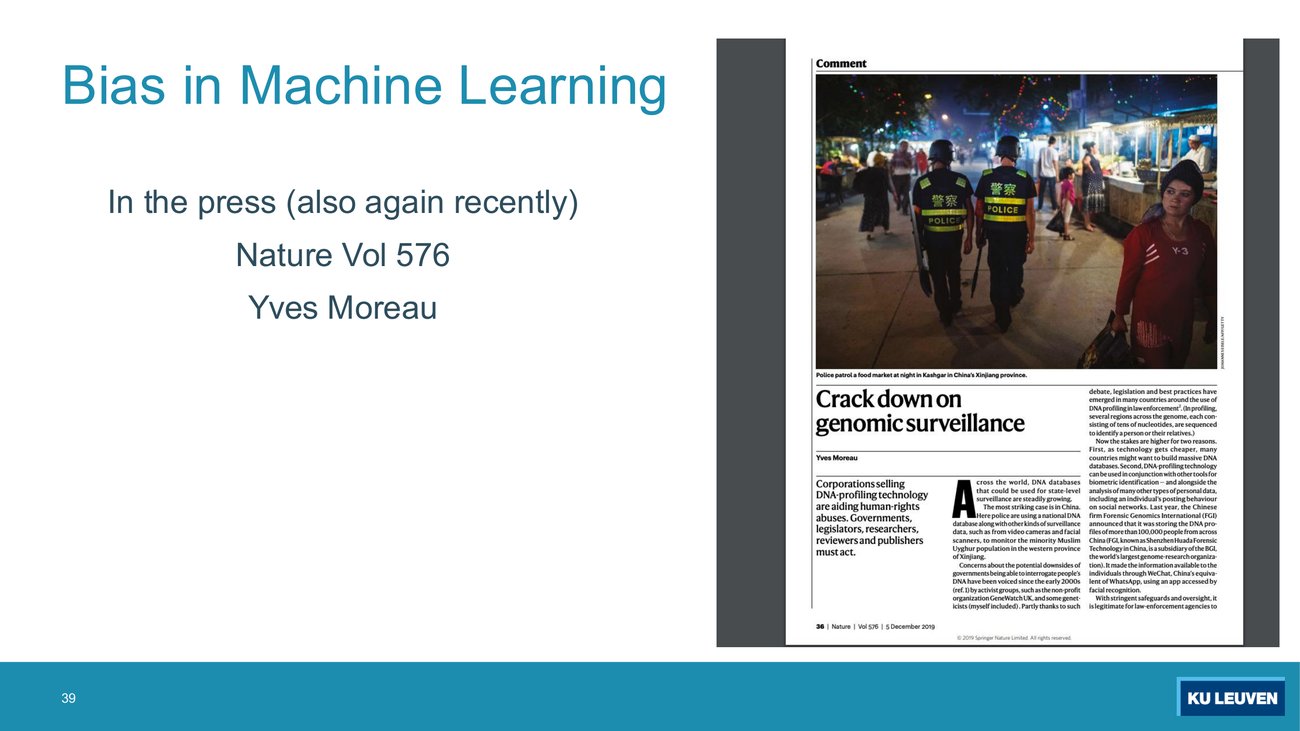
Task: name the escalation, and the pattern from section 6
Pages 36, 37, 38 and 39 are four slides in one arc. State what changes from the first to the last in terms of severity, and identify which earlier section of this chapter the arc replays.
The escalation. Page 36: embarrassing errors in consumer products, where the harm is insult and exclusion. Page 37: a research result whose existence is itself a hazard for the people it classifies. Page 38: the same technology family, DNA profiling, in the hands of a state doing population-scale surveillance, which is where the harm becomes physical. Page 39 shows the response: a report that a journal retracted a paper based on DNA of vulnerable Chinese minorities collected without proper consent.
The pattern. Section 6's biotech analogy. Page 38 is a comment piece by a researcher, Yves Moreau of KU Leuven, in the field's own leading journal, calling on governments, legislators, researchers, reviewers and publishers to act; p.39 is the community actually retracting the work. The rules are enforced from inside the field first. That is exactly what happened at Asilomar in 1975, and it is the reason the AI community's self-governance is treated in this deck as a serious instrument rather than as a gesture.
Constructed, in the sample paper's format, true or false. Built from the first line of p.36
True or false: as p.36 states it, bias in machine learning is a property of the learning algorithm rather than of the data.
Page 40 is three claims and one observation:
The third bullet is the one students skip, and it is the one that ties the slide to the figure below it. Explainability and predictability are two sides of the same demand: if you cannot say why a decision came out, you also cannot say what the system will do next time, and a system whose behaviour cannot be anticipated cannot be checked by the validation of section 12 or held to account under section 17.
The legal claim is the reason this item sits on a list of dangers rather than on a list of research topics. In the lecture the reference is to the GDPR, in the standard scenario of a loan refused by a bank, and the difficulty is stated plainly: neural networks are black-box models that are hard to interpret, so the legal requirement and the deployed technology are in tension.
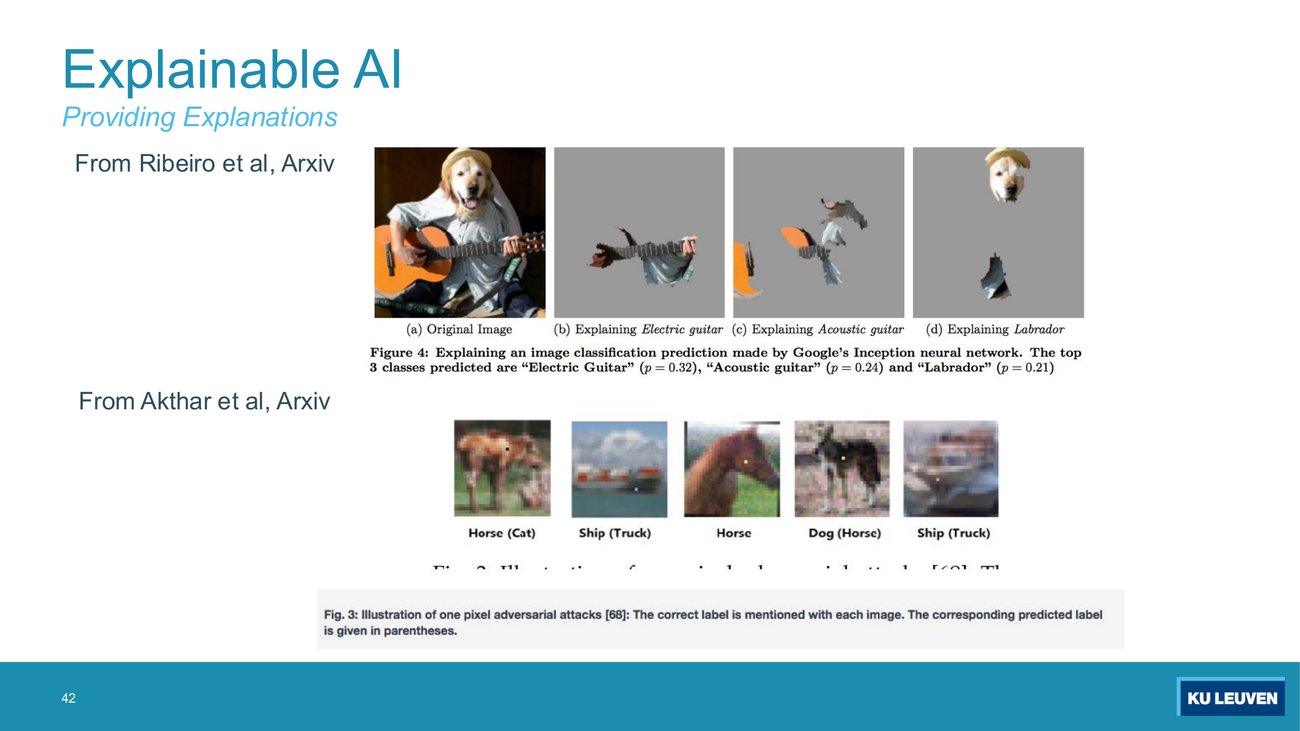
Task: say what each half of the slide demonstrates
The top row shows one photograph and three grey images. The bottom row shows five small photographs with labels in brackets. Say precisely what the three grey images are, and then say why the bottom row belongs on a slide about explanation rather than on a slide about accuracy.
Top row. The photograph is classified by Google's Inception network, whose top three classes are Electric Guitar with probability 0.32, Acoustic guitar with 0.24 and Labrador with 0.21. Each grey image keeps only the region of the input that supports one of those three classes and masks the rest: (b) explains Electric guitar, (c) explains Acoustic guitar, (d) explains Labrador. So an explanation here is a localisation: which part of the input drove this class. The lecture's companion case is the classifier that separates dogs from wolves by the snow in the background, where the explanation reveals that the feature doing the work is not the animal.
Bottom row. One-pixel adversarial attacks. The caption states the convention: the correct label is given with each image and the predicted label follows in brackets, so "Horse (Cat)" is a horse that the network calls a cat after a single pixel has been changed. It belongs on this slide because of the third bullet of p.40: a decision that a single pixel can flip is not predictable, and a system that is not predictable cannot be explained in any way that would survive contact with a new input. Accuracy is unaffected on ordinary images, which is exactly why an accuracy number does not detect this.
Constructed, in the sample paper's format, true or false. Built from the bullets on p.40
True or false: on p.40 explainability is presented as desirable for research purposes, but with no legal standing.
Page 42 states the heading and immediately drops the robot imagery: misuse by groups, individuals, nations, the military, and then Tom Mitchell's example, "What if there is an AI virus on your iPhone that wants to ruin you and your reputation?", closed with the line that connects it back to p.31: "All you need is internet access via a mobile phone; you do not need an army of robots to cause harm."
Pages 43 and 44 are the sharp case, lethal autonomous weapons, usually written LAWs. Start with the slide's first line, because it is a definitional point and definitional points are the kind of thing a fill-in question can ask: the terminology is not well chosen. The deck contrasts autonomous with automatic, and gives the Wikipedia definition it is working from: a type of military robot designed to select and attack military targets (people, installations) without intervention by a human operator.
The rest of p.43 is a debate, laid out as five arguments against and two for:
| Cons | Pros |
|---|---|
|
|
The slide also records the factual situation: clear interest from politicians around the world in developing LAWs, and the parenthetical "not always the military"; clear evidence they are being developed, with tanks in Russia, China and Turkey named; a ban being proposed by analogy to nuclear, chemical and biological weapons; an open letter at futureoflife.org; and the film Slaughterbots by Stuart Russell.
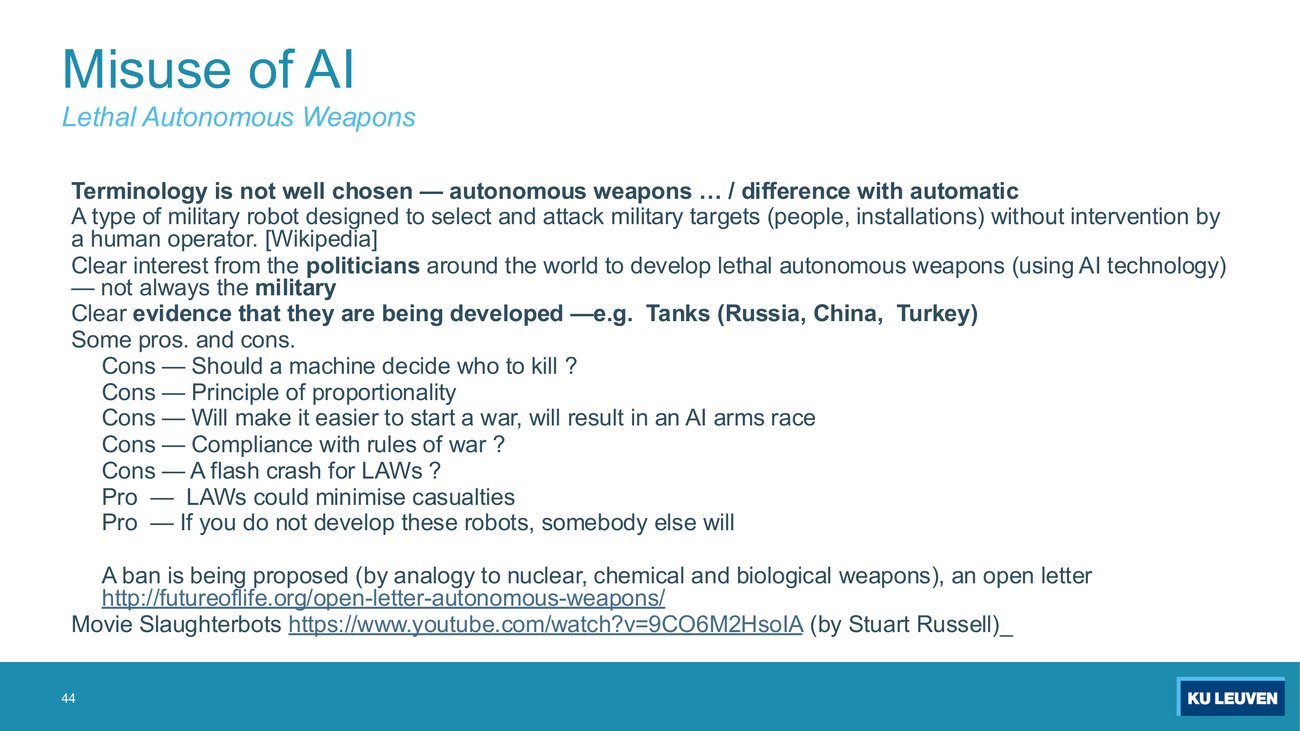
Task: find the callback
One of the five cons is a direct callback to an example from section 10, transplanted into a different domain. Which one, and what exactly is the argument it compresses? Then explain the slide's first line: what is the difference between automatic and autonomous that it says the word choice obscures?
"A flash crash for LAWs?" The 2010 Flash Crash of p.32 happened because many independent systems, each correctly following a rule of the form "sell when the price falls far enough", interacted to produce a collective outcome that was in nobody's objective function. The con asks what the equivalent looks like when the rule is "engage when the pattern matches" and the participants are armed. The point is not that a weapon becomes evil; it is that individually correct local objectives can compose into a catastrophic global one, and there is no step in any of the algorithms in this course that looks at the composition.
Automatic versus autonomous. An automatic system executes a fixed procedure that a person specified in advance, and everyone understands that the person is responsible for it. Calling a system autonomous suggests it has goals of its own and therefore, quietly, its own responsibility. The deck's whole framework says otherwise: the objective function came from a human, so an "autonomous" weapon is still executing a human specification, only at a distance where nobody is in the loop when it fires. The word choice obscures precisely the thing sections 10 and 17 want to keep visible, which is who chose the objective.
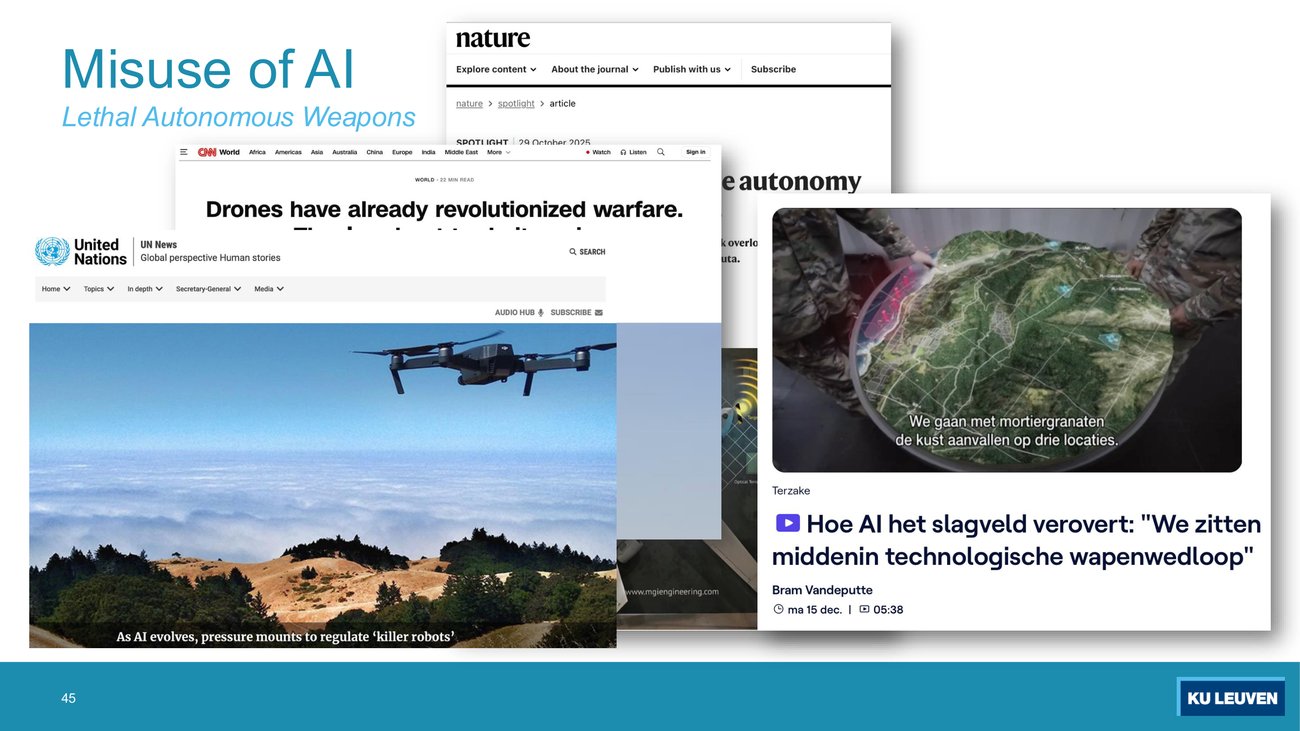
Task: say what this slide is doing in a lecture
This slide contains no argument, only four screenshots (United Nations news, CNN, a Nature spotlight dated 29 October 2025, a Flemish television item). What job is it doing, and which line on p.43 does it supply evidence for?
It converts p.43 from a position paper into a live situation. Page 43 is largely inherited from the 2017 to 2018 debate; this slide dates the same claims to the weeks around the lecture, which is what stops a student filing the topic under speculation the way p.17's utopia and dystopia can be filed.
The line it evidences is "Clear evidence that they are being developed". Note also which line it does not soften: p.43 says the interest comes from politicians around the world, and adds "not always the military", which is the counter-intuitive claim on the slide and therefore the one worth remembering.
Page 45, subtitled Security, turns from weapons to protection from misuse and from criminal AI, and it is another list of open questions. It notes that the problem is shared with other technologies, naming synthetic biology and nuclear fission, and asks: are counter measures necessary; do we need isolation facilities to seal a system off from its environment in some cases; do we need to limit it to pure question answering; what counts as risky research; and how to deal with fear and lack of trust by the general public. The second and third of those are containment ideas borrowed straight from the 1975 biotech precedent of section 6.
Constructed, in the sample paper's format, true or false. Built from the factual lines on p.43
True or false: according to p.43, the interest in developing lethal autonomous weapons comes principally from the military.
Page 46 gives the claim, the numbers, and the health warning about the numbers, in that order.
The claim. Moshe Vardi makes what the slide calls convincing claims that automation endangers jobs and increases inequality, with the books by Erik Brynjolfsson and Andrew McAfee named alongside. This is the fourth industrial revolution, Industry 4.0.
The numbers. A report study claimed that about 35 percent of jobs can be automated in the next 20 years. On automated driving, following Vardi: there are 4 million truck and taxi drivers in the United States, and 15 million jobs involve operating a vehicle.
The health warning, printed on the same slide: as always you have to take these studies with a grain of salt. The example given is an Oxford study that puts the probability of automation in the next few decades at 95 percent for repairing bikes, 89 percent for taxi driver and 25 percent for ambulance driver. Those three numbers are the argument. Bicycle repair is manual, unstructured, and in practice one of the harder things to automate; the study rates it as nearly certain. Taxi driver and ambulance driver are close to the same job in terms of the driving, yet they are separated by 64 points. A study whose numbers behave like that is measuring something other than what its headline claims.
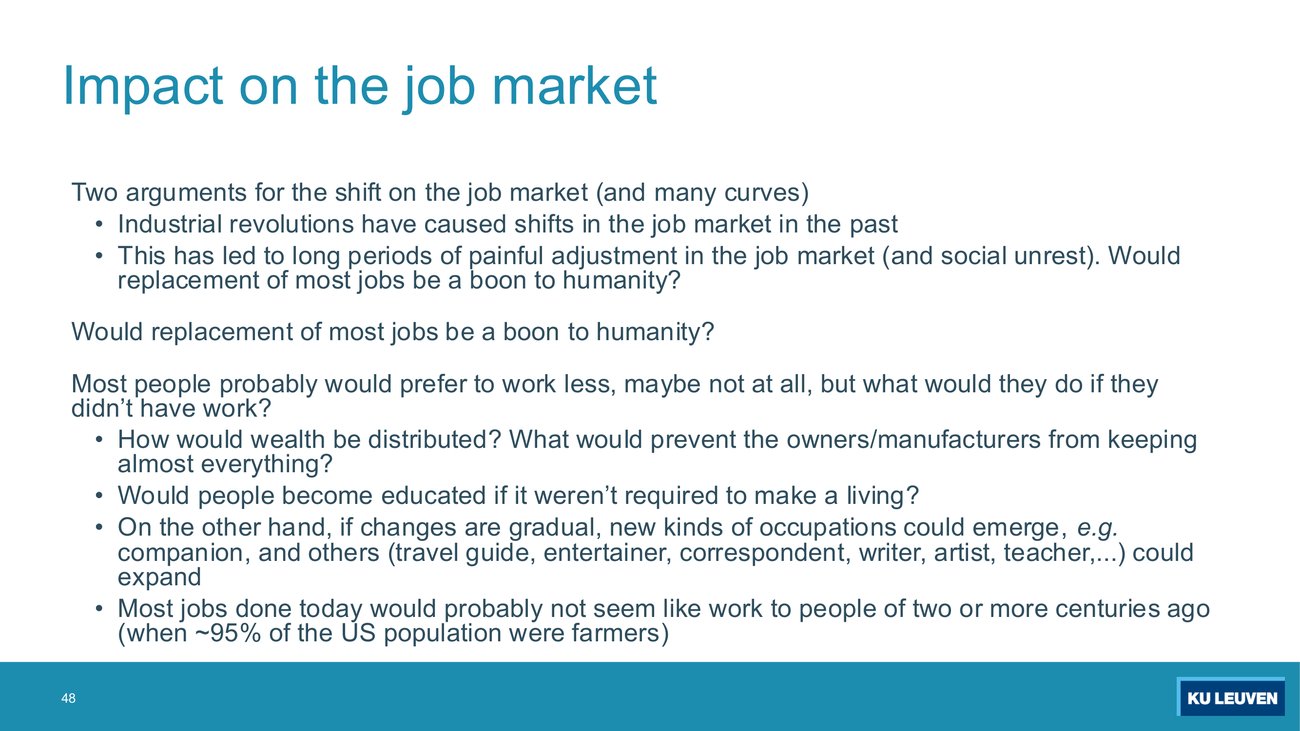
Task: separate the historical argument from the open questions
The slide gives two arguments for expecting a shift, then a question it asks twice, then four bullets. Sort them: which two bullets are the pessimistic case, and which two are the reassurance? Then state the one condition on which the reassurance depends.
The two arguments for a shift: industrial revolutions have caused shifts in the job market before, and those shifts led to long periods of painful adjustment and social unrest.
The question, asked twice: would replacement of most jobs be a boon to humanity? Most people would prefer to work less, maybe not at all, but what would they do if they did not have work?
Pessimistic bullets: how would wealth be distributed, and what would prevent the owners and manufacturers from keeping almost everything; and would people become educated if it were not required to make a living.
Reassuring bullets: new kinds of occupations could emerge, the slide naming companion, travel guide, entertainer, correspondent, writer, artist and teacher; and the historical observation that most jobs done today would probably not seem like work to people of two or more centuries ago, when about 95 percent of the United States population were farmers.
The condition, printed in the slide's own words: "if changes are gradual". The reassurance is not that the transition is harmless, it is that a slow transition can be absorbed. The first argument on the slide, that past transitions produced long periods of painful adjustment, is what happens when it is not slow enough.
Constructed, in the sample paper's format, true or false. Built from the Oxford figures quoted on p.46
True or false: the deck quotes an Oxford study putting the probability that the job of taxi driver will be automated in the next few decades at 25 percent.
Page 48 sets the problem before either rule set appears. The European Union and various countries are working on how to regulate AI, on ethical guidelines and on red lines. Then the concrete question, and it is the one the whole section turns on: liability. For a self-driving car, who is responsible when something goes wrong? The slide then names machine ethics and gives its hardest form: how to trade off a small probability of human injury against a near certainty of large material cost, with the analogy to medical practice and to insurance.
Note that the liability question is a question about people. The driver, the manufacturer, the programmer. Keep that in view, because it is the axis on which the next two slides differ.
Task: read the small print, not the laws
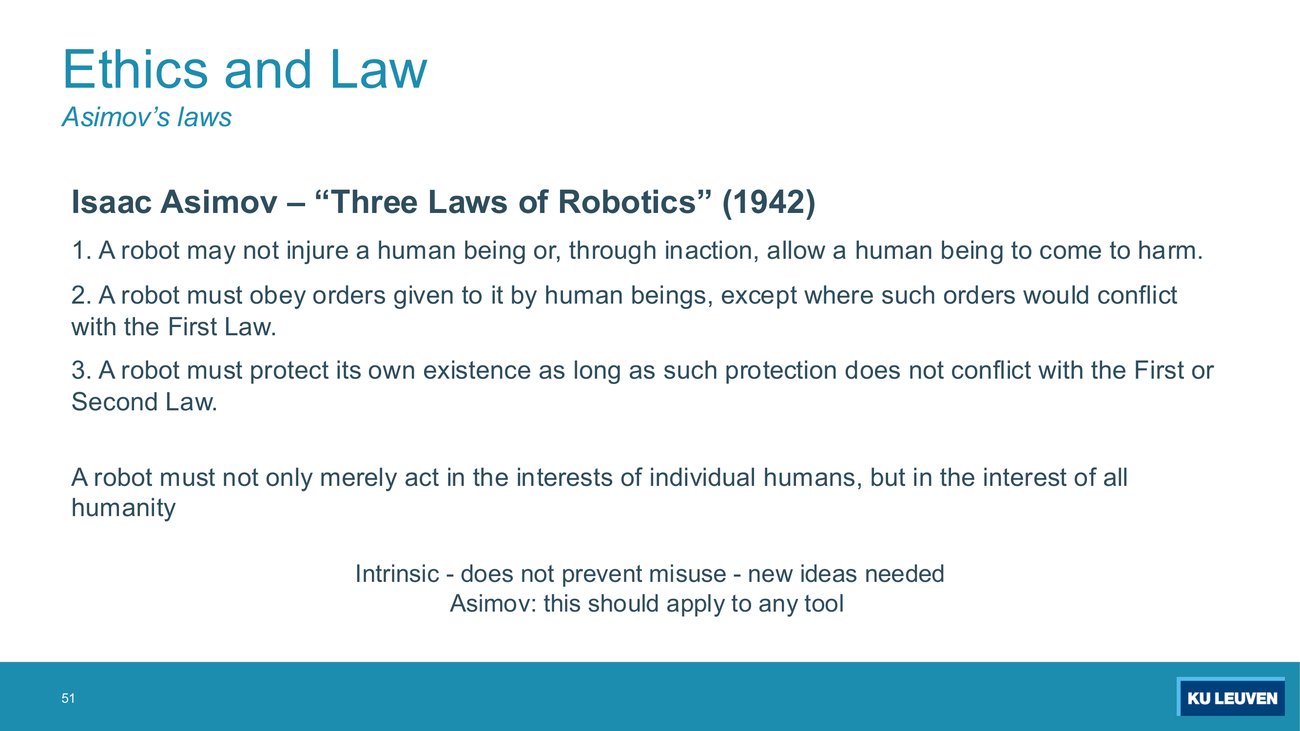
Almost everyone can recite the three laws. The examinable content on this slide is the two lines under them. Quote the verdict line, and then explain in one sentence why "intrinsic" is precisely the word that makes the verdict follow.
The verdict line is: "Intrinsic, does not prevent misuse, new ideas needed", and beside it, "Asimov: this should apply to any tool". There is also a fourth clause above them, which is not one of the three laws: a robot must not only merely act in the interests of individual humans, but in the interest of all humanity.
Why "intrinsic" makes the verdict follow: the laws are constraints placed inside the machine's own decision procedure, so they only bind machines that were built with them, by builders who wanted them. Anyone building a system for harm simply omits them. That is what "does not prevent misuse" means, and it is why section 15 is a separate item on the p.33 list rather than a solved case. Ordering the three laws by priority, which is Asimov's real technical contribution, does nothing about this: it resolves conflicts between the constraints, not the absence of the constraints.
The date to keep: 1942, as printed on the slide.
Task: state the property that differs
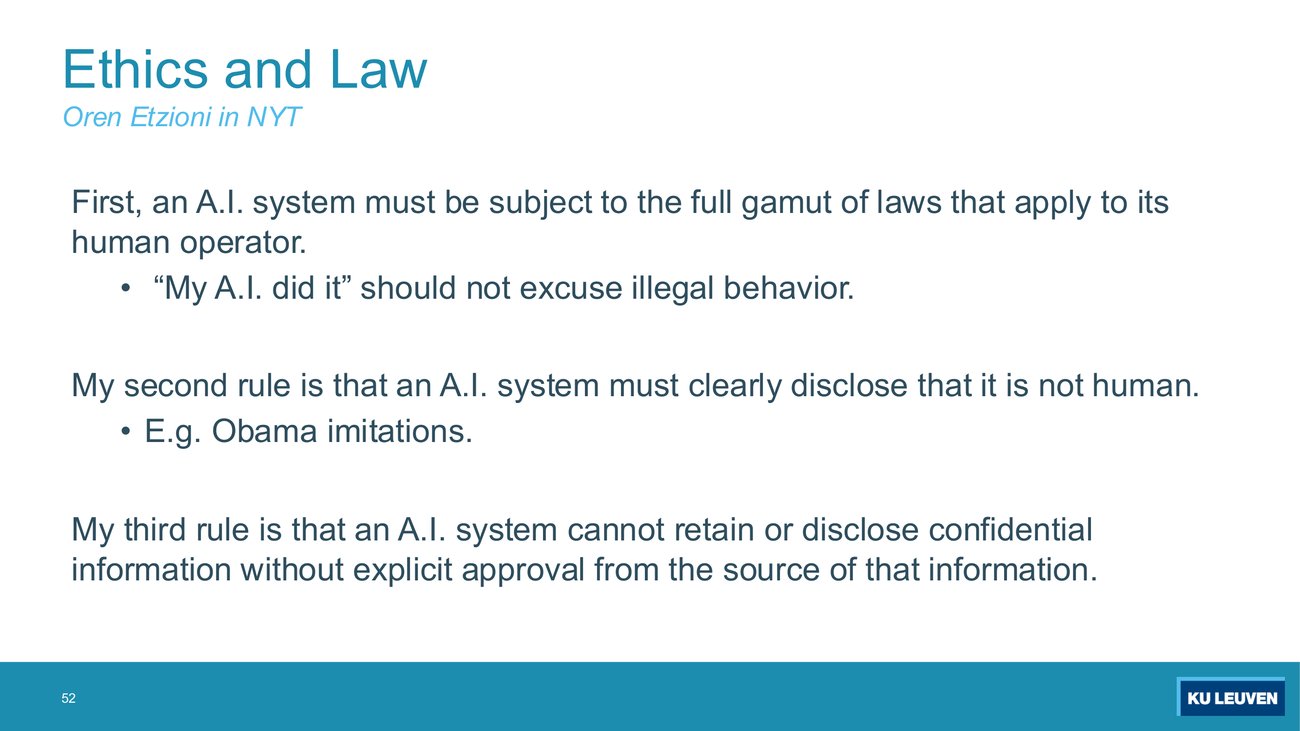
Both slides give three numbered rules about robots. Put them side by side and name the single structural difference. Then say which of Etzioni's three is the ancestor of an HLEG requirement you will meet in section 19.
The difference is who the rules bind. Asimov's laws are intrinsic: they are addressed to the machine, they constrain its own decisions, and they require the machine to reason about harm to humans. Etzioni's rules are extrinsic: rule 1 addresses the legal system, saying an AI system is subject to the full gamut of laws that apply to its human operator, with the gloss that "My A.I. did it" should not excuse illegal behavior; rule 3 addresses what the operator may do with information. Neither requires the machine to have any concept of harm. They attach the consequences to a person.
Rule 2 is the exception and the interesting one: an AI system must clearly disclose that it is not human, with the slide's example of Obama imitations. That is an interface requirement, and it reappears almost word for word inside HLEG requirement 4, transparency: "Humans need to be aware that they are interacting with an AI system, and must be informed of the system's capabilities and limitations."
Why the contrast is worth having ready: it answers the question "so what should be done?" in two incompatible ways. Build better machines, or regulate the people who deploy them. The deck's own verdict on p.49 is that the first alone does not work, and everything after p.50 is the second.
Constructed, in the sample paper's format. Built from the contrast between pp.49 and 50
Which statement best captures how Etzioni's three rules differ from Asimov's three laws, as the deck presents them?
Page 51 gives the source, the Nature article of 24 October 2018, "The Moral Machine experiment" by Awad, Dsouza, Kim, Schulz, Henrich, Bonnefon and Rahwan, Nature 563, pages 59 to 64, next to a screenshot of the website itself. The screenshot shows the design: a self-driving car with sudden brake failure, and two options drawn side by side. Swerve into the other lane, killing two women, one man and one male executive who are crossing against a red signal; or continue ahead, killing four homeless people who are crossing lawfully. The participant chooses. Millions of people did, over thirteen such dilemmas each.
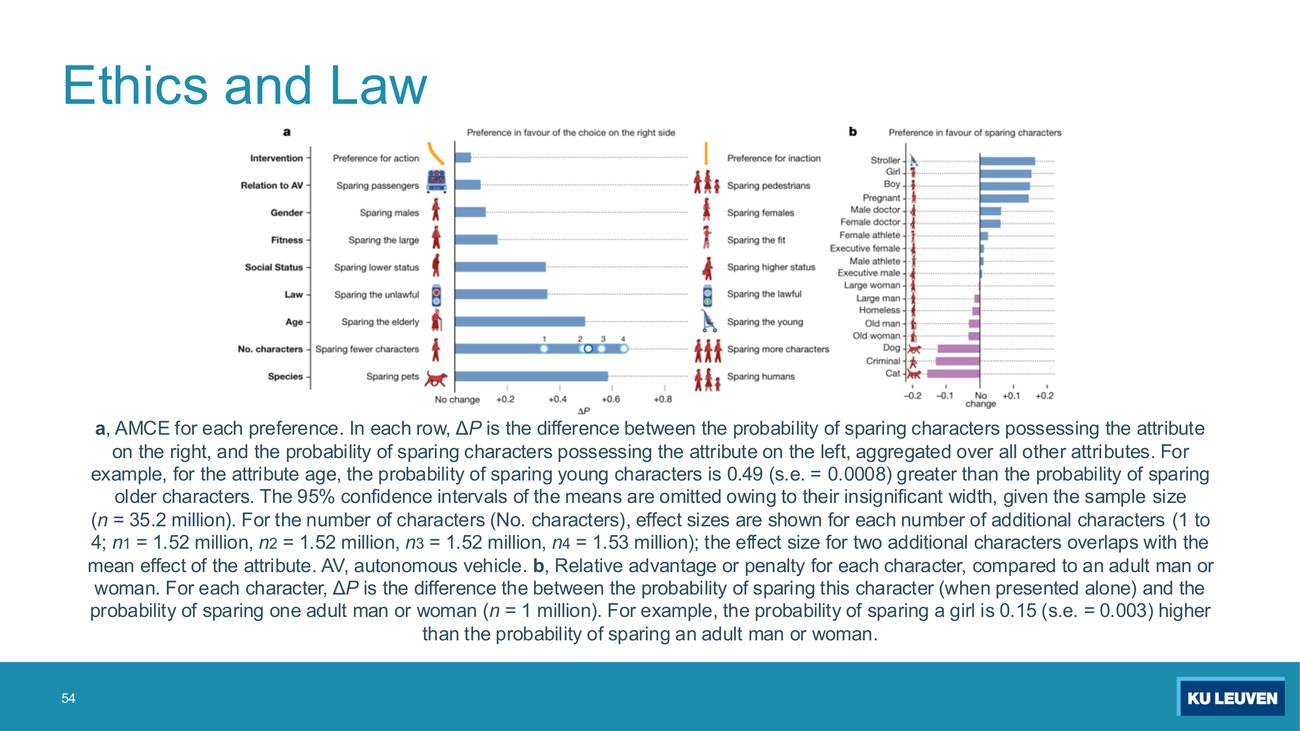
What the design measures is the effect of one attribute at a time, aggregated over everything else. That is what the figure on p.52 reports.
Task: read one number correctly, then say what it is a number about
The caption states that for the attribute age, the probability of sparing young characters is 0.49 greater than the probability of sparing older ones, with a sample of 35.2 million. (a) Say in one sentence what 0.49 measures, using the caption's own definition. (b) Then answer the question the whole slide is a trap for: does this figure tell an engineer what a car should do?
(a) It is an average marginal component effect: the difference between the probability of sparing characters that have the attribute on the right of the row and the probability of sparing characters with the attribute on the left, aggregated over all the other attributes. So 0.49 is not "people spared the young 49 percent of the time"; it is the size of the shift attributable to age once everything else is averaged out. Panel b is a different quantity: the advantage or penalty of each character type relative to an adult man or woman, so a girl at 0.15 means 0.15 more likely to be spared than an adult would be.
(b) No. It reports what tens of millions of people preferred. A preference distribution is not a rule, and the strongest effects in the figure, sparing humans over pets, sparing more characters over fewer, sparing the young over the old, sit alongside effects that no engineer would be willing to code, such as the advantage for higher social status and the penalty for the criminal in panel b. The experiment describes; it does not license.
Page 53 is the result that gets quoted least and matters most. It shows the countries clustered by their answers into three groups, labelled Western, Eastern and Southern, drawn as a dendrogram, with a set of radar plots underneath showing that the same preference axes have visibly different magnitudes in each cluster. Some preferences are near universal; others are not.
So, if the exam asks what the Moral Machine experiment showed, the full answer has three parts:
The lecture adds the standard criticism, and it is worth carrying because it is the sort of thing a "discuss" answer is graded on. A car in that state, with brakes gone and a fraction of a second left, will most likely not be in a position to make any such choice; it will do something under-determined rather than execute a moral doctrine. On that view the dilemma is a philosophy exercise rather than an engineering requirement. The experiment's value is then what it revealed about people, not what it settles about cars.
Constructed, in the sample paper's format. The trap is the answer most students give
What did the Moral Machine experiment establish?
Page 54 gives the fact and the date: on 8 April 2019, the High-Level Expert Group on AI presented Ethics Guidelines for Trustworthy Artificial Intelligence. One naming wobble to be aware of so it does not throw you: the slide titles on pp.54 and 55 read "High-Level Interest Group on AI" while the body text on p.54 and the titles on pp.56 and 57 use Expert Group and the abbreviation HLEG. It is one body. In the lecture it is described as a group of about fifty experts convened at the European Commission.
Task: three words, and one of them has two halves
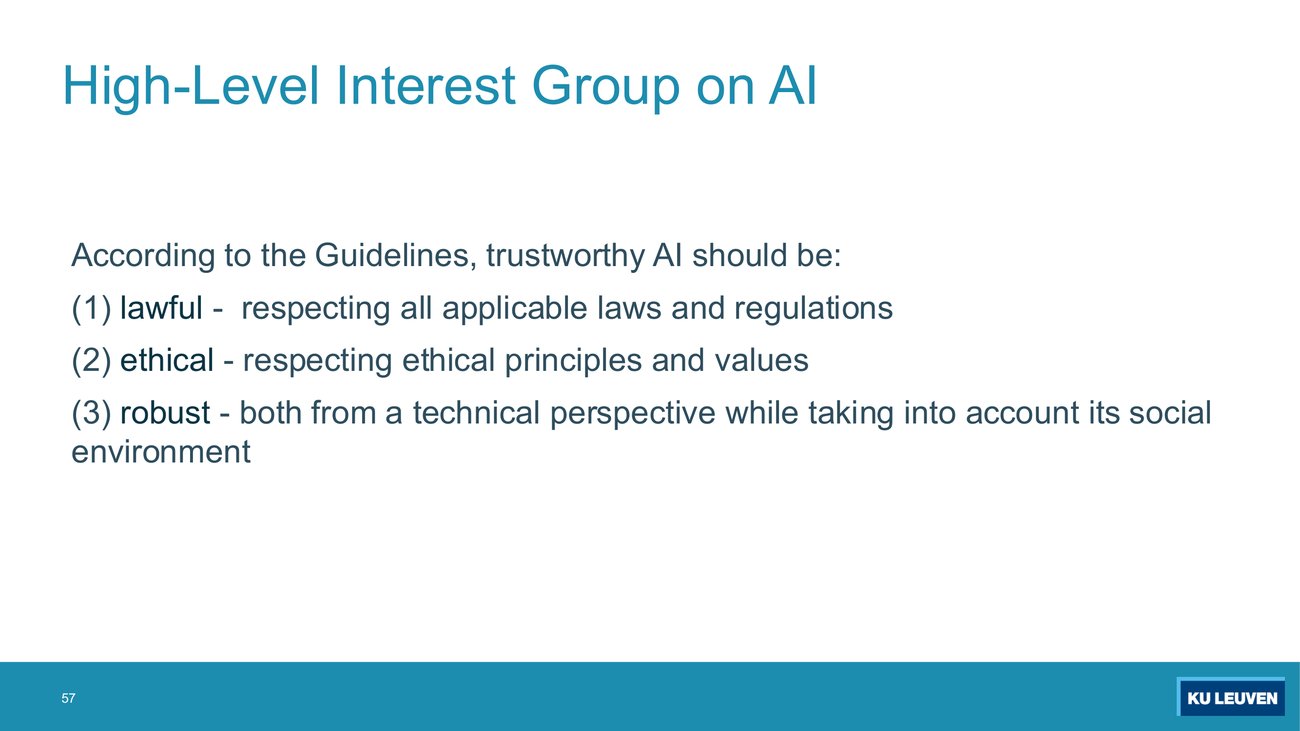
Write the three characteristics with the slide's own gloss for each. Then answer two questions about the third one: why does the slide split "robust" into two clauses, and what would a system that is lawful and robust but not ethical look like?
(1) lawful, respecting all applicable laws and regulations. (2) ethical, respecting ethical principles and values. (3) robust, both from a technical perspective while taking into account its social environment.
Why robust has two clauses. A system can be technically sound in isolation and still cause harm through how it lands in the world it is deployed into. The technical half is section 12's material, accuracy, reliability, a fall-back plan. The social half is the acknowledgement that the environment includes people who will be affected, will react and will adapt, which no test set contains.
Lawful and robust but not ethical. A system that does exactly what the law permits, reliably. The 2010 Flash Crash algorithms of p.32 were legal and worked. The classifier on p.37 broke no law. The three characteristics are stated as a conjunction precisely because each one alone is satisfiable by something nobody wants.
The three characteristics are then translated into seven key requirements, printed three on p.56 and four on p.57. This table is the compressed form; the two figures below give the slides' own wording, which is what you should be able to approximate in an answer.
| # | Requirement | The slide's own operative words |
|---|---|---|
| 1 | Human agency and oversight | AI systems should empower human beings and allow them to make informed decisions, fostering their fundamental rights; proper oversight through human-in-the-loop, human-on-the-loop and human-in-command approaches. |
| 2 | Technical robustness and safety | Resilient and secure; safe, with a fall back plan in case something goes wrong; accurate, reliable and reproducible; the only way to minimise and prevent unintentional harm. |
| 3 | Privacy and data governance | Full respect for privacy and data protection, plus data governance mechanisms covering the quality and integrity of the data and legitimised access to it. |
| 4 | Transparency | Data, system and business models transparent; traceability mechanisms; decisions explained in a manner adapted to the stakeholder concerned; humans must be aware that they are interacting with an AI system and informed of its capabilities and limitations. |
| 5 | Diversity, non-discrimination and fairness | Unfair bias must be avoided, since it can marginalise vulnerable groups and exacerbate prejudice and discrimination; systems accessible to all regardless of disability; relevant stakeholders involved throughout the life cycle. |
| 6 | Societal and environmental well-being | Benefit all human beings including future generations; sustainable and environmentally friendly; the environment and other living beings taken into account; social and societal impact carefully considered. |
| 7 | Accountability | Mechanisms to ensure responsibility and accountability for systems and their outcomes; auditability, enabling assessment of algorithms, data and design processes, especially in critical applications; adequate and accessible redress. |
A mnemonic, because seven unordered items is exactly the length at which a list starts leaking under exam pressure. The initials are H, T, P, T, D, S, A: "Humans Trust Programs That Deserve Serious Auditing". The sentence also happens to be true to the content, since the first word is human oversight and the last is auditability.
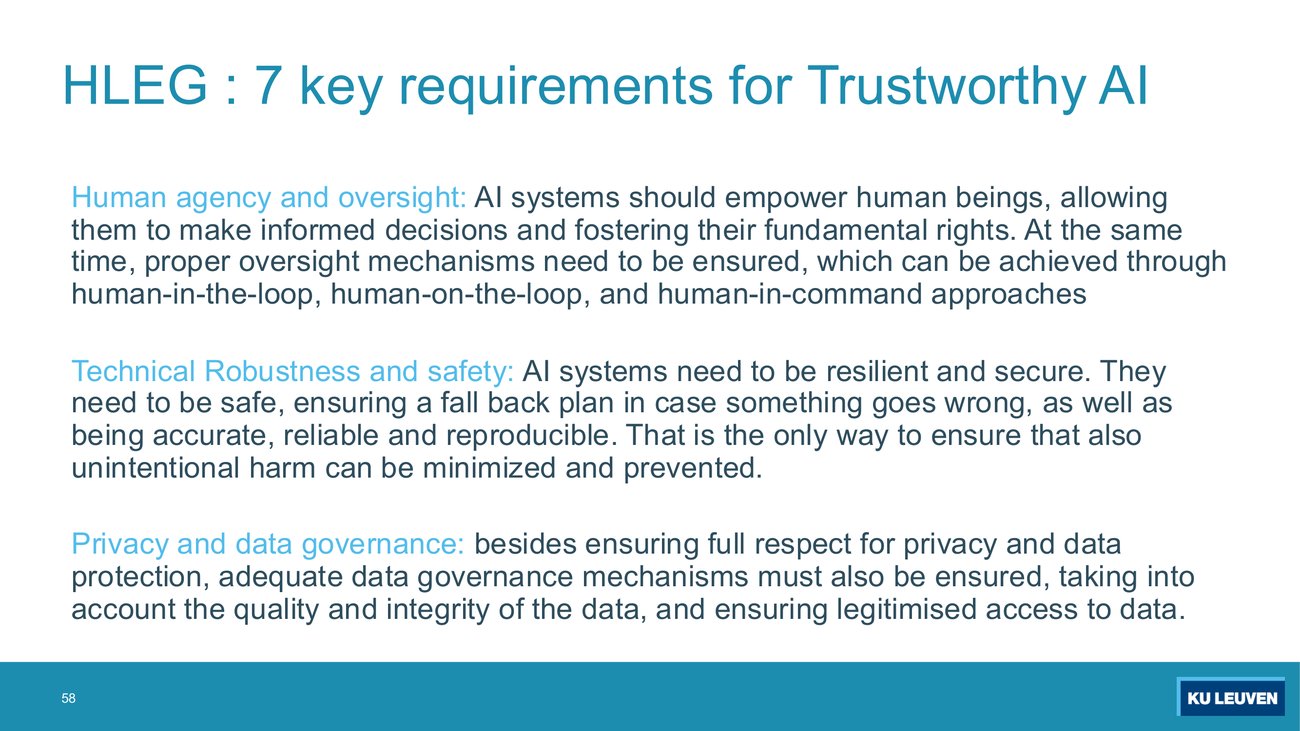
Task: three mechanisms, one axis
Requirement 1 names three oversight mechanisms. Write them down, then order them by how much control the human keeps, and say which of them the lecture said is not always possible.
The three, in the slide's order: human-in-the-loop, human-on-the-loop, human-in-command. The slide names them without defining them; in the Guidelines they run from most to least involvement in the individual decision: in-the-loop means a human can intervene in every decision cycle; on-the-loop means a human monitors the operation and can intervene; in-command means a human oversees the overall activity and decides whether, when and how to use the system at all.
The lecture, answering a question from the floor, made the point that human-in-the-loop is not always possible, and that which form of oversight is required depends on the risk level of the system and on the purpose it is used for. That is the bridge to the AI Act, which classifies systems by risk and attaches obligations accordingly.
Note also the phrase in requirement 2 that is easy to quote and easy to forget: a fall back plan in case something goes wrong. That is the compliance version of section 12's unanswered question about deployment.
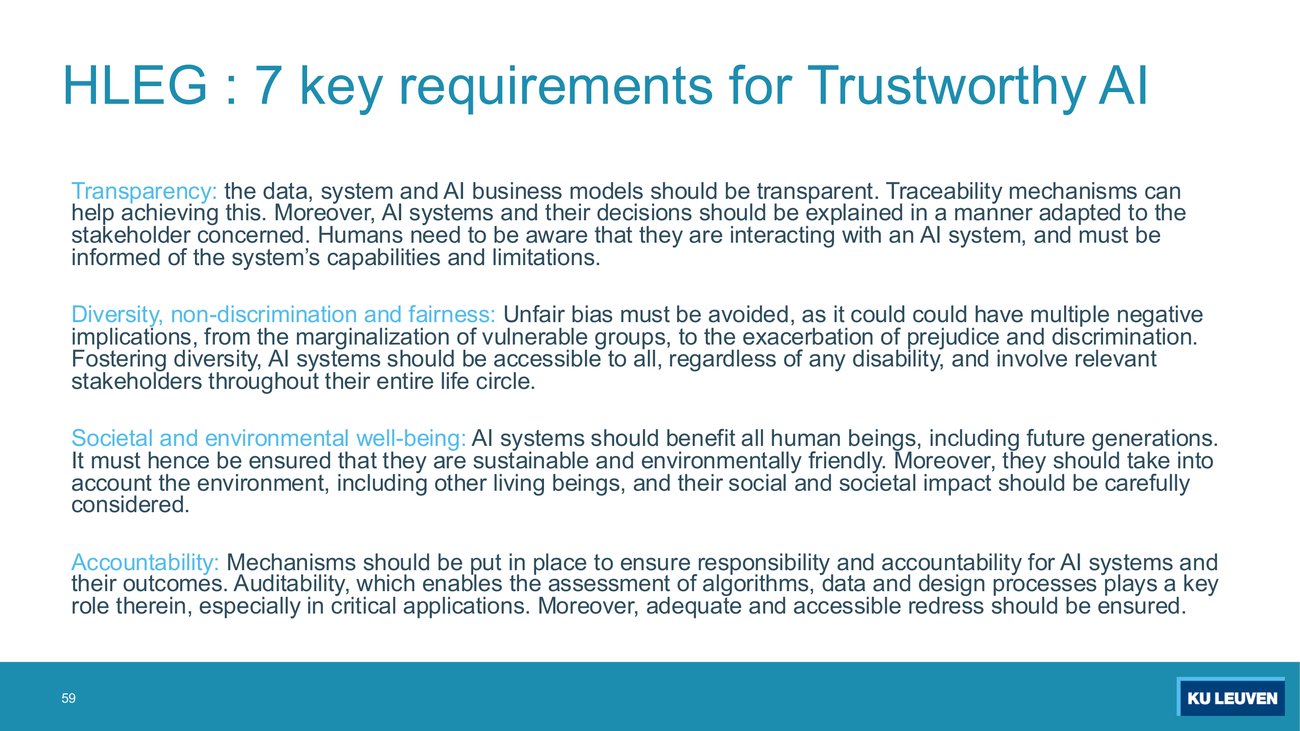
Task: map the requirements back onto the six risks
Four of the six near-term risks from p.33 are addressed by requirements on this slide or the previous one. Match them: bias, explainability, validation and verification, and the liability question of p.48. Which of the six is not covered by any of the seven?
Bias goes to requirement 5, diversity, non-discrimination and fairness ("Unfair bias must be avoided"). Explainability goes to requirement 4, transparency ("decisions should be explained in a manner adapted to the stakeholder concerned"), which also carries Etzioni's disclosure rule. Validation and verification goes to requirement 2, technical robustness and safety (accurate, reliable, reproducible, with a fall-back plan). Liability goes to requirement 7, accountability (responsibility, auditability, redress).
The one not covered is the impact on the job market. The closest the seven come is requirement 6, societal and environmental well-being, which asks that social and societal impact be carefully considered, but no requirement addresses employment. That is not an oversight to complain about; it marks the boundary of what a compliance framework for a system can do. Job displacement is a policy question about an economy, not a property of one system, which is why p.47 answers it with questions about wealth distribution rather than with a design rule.
Constructed, in the sample paper's open-question format (2 points). Answer box: about one A4 page, the size the sample paper gives its first open question
On 8 April 2019 the High-Level Expert Group on AI presented Ethics Guidelines for Trustworthy Artificial Intelligence. First state the three characteristics that trustworthy AI should have according to these Guidelines. Then list the seven key requirements into which they were translated, and explain two of the seven in one or two sentences each.
Part 1, the three characteristics. According to the Guidelines, trustworthy AI should be lawful, respecting all applicable laws and regulations; ethical, respecting ethical principles and values; and robust, both from a technical perspective and taking into account its social environment. All three are required together.
Part 2, the seven key requirements. (1) Human agency and oversight. (2) Technical robustness and safety. (3) Privacy and data governance. (4) Transparency. (5) Diversity, non-discrimination and fairness. (6) Societal and environmental well-being. (7) Accountability.
Part 3, two explained. Choose two you can say something specific about. For instance:
Human agency and oversight. AI systems should empower people to make informed decisions and should support their fundamental rights, and there must be oversight mechanisms, which the Guidelines list as human-in-the-loop, human-on-the-loop and human-in-command, running from intervention in each decision, through monitoring with the ability to intervene, to overall control of whether and how the system is used at all.
Transparency. The data, the system and the business model should be transparent, supported by traceability mechanisms; decisions should be explained in a way adapted to the stakeholder receiving the explanation; and people must be aware that they are interacting with an AI system and be informed of its capabilities and limitations.
Where the marks are. The three characteristics are worth marks on their own and are the cheapest thing on the page to get exactly right, so write them first. For the seven, the names are what is being checked; a list of seven correct names with no elaboration is worth more than three names described at length. In part 3 the marker is looking for the requirement's own content rather than a general statement about ethics, so use the Guidelines' vocabulary: fall back plan, traceability, unfair bias, auditability, redress.
If you can only remember six, write the six and add a sentence naming what the seventh area covers rather than leaving a gap. The mnemonic to carry in: Humans Trust Programs That Deserve Serious Auditing, giving H, T, P, T, D, S, A.
Two additions that lift the answer if there is room. First, name the body and the date, since the question offers both and an examiner reading fast will look for them. Second, one sentence on what happened next: these requirements were the basis for the European AI Act, whose obligations depend on the risk category of the system, and whose political agreement is the news item on p.60 of this deck. The lecture's own caveat is worth a clause too: the principles are agreed, while the technical building blocks needed to satisfy them for high-risk systems are still partly missing.
Pages 58, 59 and 60 carry the title A timely topic... and show three artefacts, all from 2023, which bring the institutional story of section 7 up to the present:
Page 61 is the conclusion slide, and it is five statements:
The last two are the deck's own answer to the question p.2 opened with, and they are not neutral. The final bullet says the purpose of the whole debate is both to get the benefits and to keep the research going. That is a position: regulation as the condition of continuing, not as an obstacle to it.
Part 1 defined rational action in four words: maximize your expected utility. Everything after it was machinery for doing that better. Search found the action sequence, heuristics made the search cheaper, constraint propagation pruned it, minimax handled an opponent, expectimax handled chance, Markov decision processes handled a world that keeps going, logic and planning handled a world you had to describe first, version spaces and pattern mining handled hypotheses you had to learn.
Every one of those algorithms takes the utility function as given. Not one of them can ask whether it is the right one. Page 32 of this deck is that observation, and it is the only place in fourteen Parts where the course looks at its own foundation from the outside: a wrong utility function is not a bug in the algorithm, it is a wrong specification of the goal, and it produces a system that is working perfectly and doing the wrong thing. Wiener's 1961 sentence, printed on that slide, is the whole course in one line: we had better be quite sure that the purpose we put into the machine is the purpose we really desire.
That is where the lecture course ends, and it is a good place to end revision too. If you can state the six near-term risks with an example each, the seven HLEG requirements, and why a misaligned system is not a broken one, you can answer anything this Part can be asked.
Lecturer aside: what counts as the source of truth
"the slides and the material for the exercise sessions uh are the main source of reference. So that's the basis of what you need to know uh for the evaluation."
(Lecturer, T1)
For this Part that sentence has an edge to it: there is no exercise session, so the slides are the whole of it. Everything examinable in this chapter is on the 64 pages of the deck, and the lecture material used above is there to explain those pages rather than to add to them.
Exam signal: how this Part is likely to appear, and the three mechanics to fix now
The likely format. The 2023 sample paper contains no Part 14 item, and the lecturer's stated aim of a balanced paper is an aspiration rather than an observed property of that paper, which also omits Parts 1, 3 and 8 (reference A item 3, including its correction). But this is a full lecture with two crisp numbered lists, and the theory paper has an open-question block worth 4 points in two questions. An open question of the form "name and explain" is the format to prepare for. Multiple choice is possible on the factual details (the Oxford percentages, who wants LAWs, what Asimov's laws are labelled as); a fill-in on the triad or on the definition of a lethal autonomous weapon is the other cheap item to write.
Mechanic 1: the answer box is the instruction. The lecturer says fill-in questions "can also be short answers that you need to provide", and that "the boxes also give an indication of the expected length given a regular written font size" (Lecturer, T9). The sample paper backs this up: the two 2-point open questions get most of a page each, and question 3.1 gets an extra full page. So a two-line answer in a one-page box is a signal you have missed part of the question, and an answer overflowing a four-line box is a signal you are writing an essay where a definition was wanted.
Mechanic 2: never leave a true or false item blank. Marking is plus 0.5 correct, minus 0.25 wrong, 0 for both boxes empty (Lecturer, T9). The expected value of answering with confidence p is 0.75p minus 0.25, which is positive whenever p is above one third. A pure coin flip on a two-way item is worth +0.125. Across the whole 8-item block, blanket guessing is worth +1.0 in expectation and blanket abstention exactly 0. There is no item on which a blank is the better play.
Mechanic 3: hand in the theory half when you are done with it. Three hours for both parts, theory first, and you decide when to hand it in and receive the exercise part. This Part is theory-only and it is fast to write if the lists are memorised, so it is a good candidate to answer early rather than to leave for the last ten minutes.
Classic mistakes on this Part, in order of how often they would cost marks: (1) answering a near-term question with the singularity, the Terminator or an intelligence explosion, which p.31 files as myths; (2) giving the six risks as bare headings with no example, when the whole content of the section is the examples; (3) describing a misaligned system as broken or malfunctioning, when p.32's point is that it is working; (4) producing five or six of the HLEG requirements and stopping, when the question says seven and the names alone carry the marks; (5) reading the Moral Machine as a finding about what cars should do rather than about what people prefer.
No 2023 sample-exam wording exists for any Part 14 term, so the fourth column gives the slide's own printed phrasing, which is what an examiner would quote from.
| Term | Precise definition | Plain paraphrase | Phrasing on the slide |
|---|---|---|---|
| Hype cycle | Gartner's curve of expectations against time for a technology, in five phases: Innovation Trigger, Peak of Inflated Expectations, Trough of Disillusionment, Slope of Enlightenment, Plateau of Productivity (pp.8-12). Each entry also carries a marker giving the estimated time to plateau, in bands, with "obsolete before plateau" as a separate case. | A picture of how loudly a technology is talked about, not of how well it works. | "It is high summer" (title of pp.8-12); axis label "Expectations". |
| Singularity | The point at which an ultraintelligent machine, one that far surpasses all the intellectual activities of any man however clever, designs better machines than itself, producing an intelligence explosion (I. J. Good, 1965, p.16). Sketched with two outcomes, utopia or dystopia (p.17), and no date (p.19). | Machines that improve themselves, faster than we can follow. | "the first ultraintelligent machine is the last invention that man need ever make" (p.16). |
| Value misalignment | The condition in which the value or utility function an AI system optimises is not the one its designers intended. Since "defining the function is programming the AI system", such a system is functioning correctly on a wrong specification, producing unexpected behaviour rather than a fault (p.32). | It does exactly what you asked, which is not what you wanted. | "Value misalignment"; "We had better be quite sure that the purpose we put into the machine is the purpose we really desire" (Wiener 1961, p.32). |
| Validation and verification (V and V) | The software-engineering pair applied to AI: verification asks whether the system meets its specification, validation whether the specification is the right one. Page 34 asks how either is possible when learning is involved, what guarantee can be given (epsilon and delta), what happens in partially known environments, and how alignment of the value function could be guaranteed. | Did we build the thing right, and did we build the right thing. | "How can we guarantee that an AI system is safe? When can we deploy it?" (p.34); "Reasoning + Perception Needed" (p.35). |
| Bias in machine learning | The reproduction, in a learned classifier's decisions, of biases present in its training data. Attributed to Kate Crawford (NIPS 17). Named application areas: granting loans, scanning for suspects by police (p.36). | The model learns the pattern in the data, including the ones you would not have chosen. | "every classifier that has been learned reflects the biases of the data it has been trained on" (p.36). |
| Explainable AI (XAI) | The requirement that AI systems justify and explain their decisions, especially where those affect humans, backed by a legal right to an explanation, and entailing that the systems be predictable (p.40). Illustrated by localisation-style explanations of a classifier's top classes and by one-pixel adversarial attacks (p.41). | The system has to be able to say why, and to behave the same way tomorrow. | "we have the right to an explanation, recent legal requirement"; "this also means AI systems should be predictable" (p.40). |
| Misuse of AI | Deliberate use of AI systems for harm, by groups, individuals, nations or the military, requiring no robot and no physical presence. Includes criminal use, and raises containment questions such as isolation facilities and restriction to pure question answering (pp.42, 45). | Someone using it on purpose to do damage. | "All you need is internet access via a mobile phone; you do not need an army of robots to cause harm" (p.42). |
| Lethal autonomous weapon (LAW) | "A type of military robot designed to select and attack military targets (people, installations) without intervention by a human operator" (p.43, quoting Wikipedia). The deck flags the term itself as badly chosen, contrasting autonomous with automatic, and notes that interest comes from politicians, not always the military. | A weapon that picks its own target once switched on. | "Terminology is not well chosen, autonomous weapons ... difference with automatic"; "A flash crash for LAWs?" (p.43). |
| Asilomar AI principles | 23 principles for beneficial AI agreed at the 2017 Asilomar meeting, in three groups: Research Issues (1-5), Ethics and Values (6-18), Longer-term Issues (19-23) (pp.23-26). Named after the 1975 recombinant-DNA conference at the same site (p.21). | The AI field writing its own rules, copying what biology did in 1975. | "The 23 Asilomar principles of Beneficial AI" (p.22); "Value Alignment" is principle 10, "AI Arms Race" is 18, "Recursive Self-Improvement" is 22. |
| Asimov's three laws | 1942 fictional laws of robotics, ordered by priority: no injury to a human by action or inaction; obey human orders except where they conflict with the first law; protect its own existence except where that conflicts with the first two. The deck adds a clause about the interest of all humanity, and its own verdict (p.49). | Safety rules written inside the robot. | "Intrinsic, does not prevent misuse, new ideas needed"; "Asimov: this should apply to any tool" (p.49). |
| Etzioni's three rules | Oren Etzioni in the New York Times: an AI system is subject to the full gamut of laws that apply to its human operator; it must clearly disclose that it is not human; it cannot retain or disclose confidential information without explicit approval from the source (p.50). Extrinsic: they bind operators and the legal system, not the machine's reasoning. | Rules for the people who deploy it, plus one rule about telling you it is a machine. | "My A.I. did it should not excuse illegal behavior"; "E.g. Obama imitations" (p.50). |
| Moral Machine experiment | Awad et al., Nature 563, 59-64 (2018): an online experiment collecting 35.2 million decisions on pairwise dilemmas for a self-driving car with brake failure, reporting the average marginal component effect of each attribute (p.52) and clustering countries into Western, Eastern and Southern groups whose preferences differ systematically (p.53). | Millions of people voting on who a runaway car should hit, and the answers depend on where they live. | "What should the self-driving car do?" (p.51); "the probability of sparing young characters is 0.49 greater than the probability of sparing older characters" (p.52 caption). |
| Trustworthy AI (HLEG triad) | The three characteristics required by the EU High-Level Expert Group's Ethics Guidelines of 8 April 2019: lawful, ethical and robust, the last both technically and with regard to the system's social environment (pp.54-55). Required jointly. | Legal, decent, and it has to actually work in the world it is put into. | "trustworthy AI should be: (1) lawful (2) ethical (3) robust" (p.55). |
| The seven key requirements | The translation of the triad into obligations (pp.56-57): human agency and oversight (through human-in-the-loop, human-on-the-loop and human-in-command approaches); technical robustness and safety; privacy and data governance; transparency; diversity, non-discrimination and fairness; societal and environmental well-being; accountability. The basis of the later EU AI Act (p.60). | The seven boxes an AI system has to tick in Europe. | "HLEG : 7 key requirements for Trustworthy AI" (pp.56, 57). |
Constructed, in the format of the sample paper's fill-in block (question 2.2 is written with blanks exactly like this)
Fill in the blanks.
(i) According to the Ethics Guidelines of the High-Level Expert Group, trustworthy AI should be __________, __________ and __________.
(ii) A lethal autonomous weapon is a type of military robot designed to __________ and __________ military targets without __________ by a human operator.
(iii) A hype cycle plots __________ against time; its five phases are the innovation trigger, the peak of __________ expectations, the trough of __________, the slope of __________ and the plateau of __________.
(i) lawful, ethical, robust (p.55). Order as printed; the marks are for the three words, not for the glosses.
(ii) select and attack military targets without intervention by a human operator (p.43).
(iii) expectations; peak of inflated expectations; trough of disillusionment; slope of enlightenment; plateau of productivity (pp.8-12).
Marking note. The 2023 fill-in block is worth 2 points over two questions, so an item like this is scored on the exact terms. The guessing correction (plus 0.5, minus 0.25) is printed on the sample paper under the multiple-choice block only, so on a fill-in a blank can only lose you marks: write your best guess in every gap.
Sources for this chapter: FAI_Part14_AIDebate_25-26.pdf (64 pages, verified with PyMuPDF; cited throughout by PDF page index, which runs 0 to 3 pages behind the printed slide numbers as set out in the header) and the Part 14 lecture recording, transcript T13. Verbatim lecturer quotes are drawn only from the pack's verified quote reference and attributed (Lecturer, Tn); lecture material used to explain a slide is marked as such in the text. Slide text is quoted as printed, with the deck's dashes rendered as commas. The 2023 sample theory exam supplies one verbatim item (multiple choice 1.7, set on Part 9); every other embedded question is constructed and labelled. Two figure-manifest labels were corrected against the slides: p.12 is the June 2025 hype cycle, and p.33 lists six risks, not four. There is no exercise session for this Part.